
Meteorology · Agriculture · Technical guides
Doppler radar precipitation gauge at the weather station: intensity, precipitation type and maintenance-free sensing
A teaching guide to the Doppler radar precipitation gauge in research: 24 GHz principle (fall speed and drop size), rain/snow/hail classification, intensity without a funnel or moving parts, comparison with tipping bucket, weighing gauge and capacitive detector, key specs (±10%, 0.01–200 mm/h, RS485/ModBus), installation and QC with wind and temperature, energy budget without a heater, and Brazil use cases (urban hydrology, remote stations and network QC).
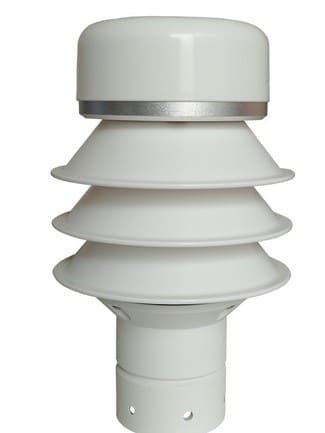
When the research question is near-real-time precipitation intensity and hydrometeor type — rain, snow or hail — without relying on a funnel, tipping bucket or load cell, the instrument that fits is a Doppler radar precipitation gauge. Unlike a tipping-bucket rain gauge or a weighing rain gauge, it does not accumulate water. Unlike a capacitive precipitation detector, it is not limited to a wet/dry flag: it estimates intensity and classifies type from particle fall speed.
This guide is for faculty, graduate students and researchers at public universities and institutes in Brazil. The aim is to explain the 24 GHz Doppler principle, what the radar delivers (and what it does not), when it complements — rather than blindly replaces — tipping bucket, weighing gauge and capacitive detector, and how to cross-check it with wind, temperature and the station data logger.
Why intensity and type without moving parts matter
In many experimental designs, three limitations of mechanical gauges weigh together:
- Maintenance and blockage. Leaves, insects, nests and ice in the funnel cause undercatch or false tips. At remote stations (highlands, wetlands, Amazon, semi-arid sites), every field visit is expensive.
- Onset and end delay. A tipping bucket only “sees” rain after the bucket volume is reached; weighing needs a trustworthy Δmass. Radar, watching falling drops, responds faster to onset and cessation — useful for temporal QC and fast urban hydrology.
- Precipitation type. Bucket and weighing gauges measure depth (or liquid equivalent). Separating rain, snow and hail needs a dedicated sensor, a heater, or post-processing with temperature. A precipitation Doppler radar classifies the hydrometeor from the fall-speed signature.
None of this makes radar “better” in absolute terms. Typical accuracy of ±10% of reading (liquid precipitation) and the lack of a WMO-calibrated funnel mean that, for official depth series, tipping bucket and weighing gauges remain the reference. Radar shines where zero maintenance, typing and fast response matter — especially when it works alongside the other instruments.
24 GHz Doppler principle: fall speed, drop size and typing
The instrument emits a 24 GHz microwave signal and observes the echo from particles crossing a small measurement volume (on the reference product sheet, a measurement surface of 8 cm²). By the Doppler effect, the frequency shift of the echo is proportional to the particle’s radial velocity — in practice, fall speed in the illuminated volume.
The underlying physics is familiar from cloud microphysics: larger drops fall faster (until terminal velocity); snowflakes and hailstones have velocity–size relationships different from liquid raindrops. By comparing the velocity distribution (and, in the sensor firmware, the spectrum linked to apparent particle size), the device estimates:
- intensity of liquid precipitation (mm/h);
- type: no precipitation, rain, snow, hail (the Spanish product description of the same unit also mentions snow-covered rain and freezing rain as classes derived from the velocity rate).
Typical liquid drop range on the sheet: 0.5 to 5.0 mm. Sampling: once per second. Intensity resolution: 0.1 mm. Liquid intensity range: 0.01 to 200 mm/h.
In short: the radar does not weigh water or count bucket tips. It infers intensity from particle dynamics in air. That removes funnel and moving parts — and creates the need for QC with wind and temperature, because horizontal drop motion and phase (solid/liquid) affect how the spectrum is interpreted.
Radar versus tipping bucket versus weighing versus capacitive detector
| Question | Doppler radar | Tipping bucket | Weighing | Capacitive detector |
|---|---|---|---|---|
| Intensity in mm/h | Yes (estimated) | Yes (via tips/time) | Yes (via Δmass/time) | No (relative wetting only) |
| Accumulated depth (mm) | Integrable, with typ. ±10% | Yes (classic reference) | Yes (strong at low intensity) | No |
| Type (rain/snow/hail) | Yes (classification) | No (liquid equivalent only) | Limited (mass; type indirect) | No (wet/dry state) |
| Fast onset/end | Yes (high sensitivity) | Delay from bucket resolution | Delay from mass threshold | Yes (ON/OFF; deliberate OFF delay) |
| Moving parts / funnel | No | Yes | Funnel + load cell | No (sensing element) |
| Ice heater | Not required on the radar | Often yes | Often yes | Yes (on heated detectors) |
| Field maintenance | Near zero | Funnel/filter cleaning | Cleaning + cell checks | Delicate element cleaning |
| Typical liquid accuracy (sheet) | ±10% of reading | Model/calibration dependent | Model/calibration dependent | N/A (does not measure mm) |
Practical rule for the design:
- radar only → intensity, typing and remote operation with little maintenance; document ±10% uncertainty and the QC protocol;
- bucket or weighing only → reference depth, with maintenance visits and inherent delay;
- radar + bucket/weighing → the robust layout: the mechanical gauge anchors depth; the radar delivers typing, fast response and fault diagnosis (clogged funnel, tips without particles, etc.);
- radar + capacitive detector → temporal redundancy (onset/end) with distinct physical principles — useful for QC and wet/dry sampling.
Specifications that matter for the experimental design
Taking as reference the radar precipitation gauge in the Hensistemas catalogue (ref. EIC-28RS2E), the product sheet lists:
- 24 GHz Doppler radar; measurement surface 8 cm²;
- types: no precipitation / rain / snow / hail;
- liquid intensity 0.01–200 mm/h; resolution 0.1 mm; drops 0.5–5.0 mm;
- accuracy ±10% of reading (liquid precipitation);
- sample rate 1×/s;
- interfaces RS485 and RS232; protocols ModBus, NMEA-0183 and ASCII;
- power DC 7–30 V; 130 mA @ 12 V (about 1.6 W);
- operating −40…+70 °C; RH 0–100%;
- body Ø105 × 178 mm, aluminium alloy + ABS, mass 0.45 kg.
Design notes to record in the experiment metadata:
- ±10% is not “bucket error”. Treat it as method uncertainty of the radar approach and, if the series is critical, intercompare with a mechanical gauge on the same site.
- Digital interfaces. RS485/ModBus and NMEA/ASCII fit station loggers and telemetry — see the guides on choosing a data logger and weather-station telemetry.
- No heater. For solid precipitation the radar classifies by Doppler; it does not need to melt ice in a funnel. That is an energy advantage on a small solar panel — and does not by itself replace a dedicated hail sensor when mechanical impact is the variable of interest.
- Small measurement volume (8 cm²). Spatial representativeness depends on installation (height, clearance from obstacles) and wind regime, not on a 200 or 400 cm² funnel.
Station installation and QC with wind and temperature
- Siting. Open field, away from buildings, trees, towers and any surface that causes splash or shades the illuminated volume. The radar “sees” particles in air: an overhang or a panel above can falsify onset/end and typing.
- Mounting. Compact body (Ø105 × 178 mm, 0.45 kg) on a mast or rigid arm, levelled as specified by the manufacturer. Keep the sensing axis clear; avoid a loose cable hitting the housing (vibration and mechanical noise).
- Height. Mentally align with the site’s reference rain gauge height (when present), so wind and exposure are comparable in cross-QC.
- Wind. Drops with a horizontal component change apparent radial velocity in the volume. An ultrasonic anemometer on the same mast — and the guide on wind measurement — let you flag strong-wind periods when radar intensity should be interpreted with care.
- Temperature. Cross typing (snow/hail/rain) with air temperature: snow reported with T ≫ 0 °C, or rain with T ≪ 0 °C, deserves review (temperature inversion, calibration, or mixed precipitation).
- Capacitive detector. The capacitive precipitation detector marks onset/end by wetting; the radar marks particles in fall. Systematic disagreement (radar “rain” without capacitive ON, or the reverse) is a cheap QC alarm.
- Logger. Prefer a station data logger with RS485/ModBus (or RS232) and stable 12 V power. Record intensity, type and, if the protocol allows, sensor diagnostics on the same time base as the rain gauge and wind.
Minimum daily QC: (a) radar intensity > 0 without tips/Δmass on the mechanical gauge for a long period? (b) mechanical tips without radar typing? (c) “snow/hail” typing inconsistent with temperature? (d) wind above the experiment threshold during intensity peaks?
Maintenance and power
The main operational advantage of a precipitation radar is no moving parts and no funnel. There is no bucket to recalibrate on a schedule, no filter to clean, and no classic risk of leaves blocking the inlet. At remote stations that cuts visits and silent failures.
On the energy side: 130 mA @ 12 V (~1.6 W) is a predictable budget, and the absence of a funnel heater avoids tens-of-watts peaks in frost — an important contrast with heated gauges and with a capacitive detector running its heater. On a solar panel sized to the limit, that point alone can decide the layout (radar + unheated bucket vs. heated bucket).
Residual maintenance is typically visual inspection of the measurement window/volume (coarse dust, webs, bird residue), checking mast hardware and RS485 continuity, and verifying firmware/protocol at commissioning. Do not invent “funnel calibration” routines the instrument does not have: intercompare against a reference rain gauge if the research requires it.
Use cases in Brazil
- Urban hydrology and flash floods. Intensity at 1 Hz and fast onset response help feed runoff models on sealed basins (capitals and mid-size cities), provided ±10% uncertainty is in the metadata and, ideally, a reference gauge sits on the same network.
- Remote stations. Amazon, Cerrado, Pantanal, southern highlands and semi-arid sites: fewer visits for clogged funnels and no heavy heater on the solar budget.
- Solid and mixed precipitation. South and highland regions: snow/hail typing crossed with temperature; combine with a hail sensor when mechanical impact is the variable (crop insurance, damage research).
- Rain-gauge network QC. Radar as a “sentinel” beside bucket/weighing: detects clogged funnels, ghost tips and events below bucket resolution.
- Microphysics teaching / research. Demonstrate in the field the velocity–size link and the difference between detecting an event, measuring depth and classifying hydrometeors — with a full station (wind, temp, logger).
Featured product: Doppler radar precipitation gauge
In the Hensistemas catalogue, the reference instrument for this role is the radar precipitation gauge (ref. EIC-28RS2E). From the published sheet:
- 24 GHz Doppler radar, measurement surface 8 cm²;
- classification no precipitation / rain / snow / hail;
- liquid intensity 0.01–200 mm/h, resolution 0.1 mm, drops 0.5–5.0 mm;
- accuracy ±10% of reading (liquid);
- sampling 1×/s; RS485/RS232 with ModBus, NMEA-0183 and ASCII;
- DC 7–30 V, 130 mA @ 12 V; −40…+70 °C; RH 0–100%;
- Ø105 × 178 mm, aluminium + ABS, 0.45 kg;
- no moving parts; faster onset/end response than mechanical sensors; no ice heater.
For the researcher, the strengths are typing + intensity without a funnel, station-grade digital interfaces and a predictable energy budget. The points to plan are ±10% uncertainty, QC with wind/temperature, and the conscious decision not to drop the tipping bucket or weighing gauge when official experimental depth is non-negotiable.
Catalogue alternatives and complements
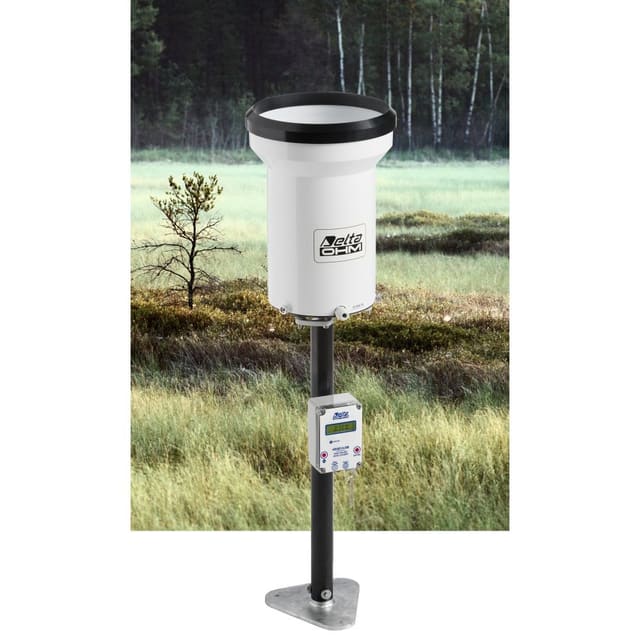
- Tipping-bucket rain gauge (ref. HD2013): classic depth and intensity by tipping; guide: tipping bucket in research.
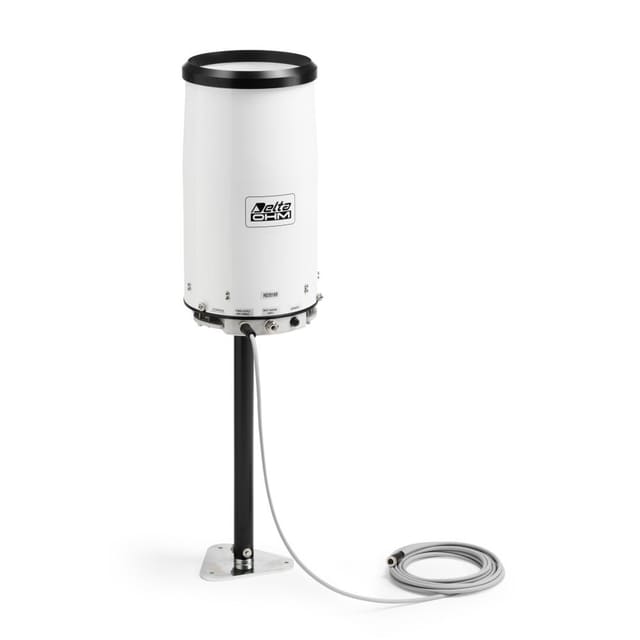
- Weighing rain gauge (ref. HD2016): load cell for low intensity and solids; guide: weighing rain gauge.
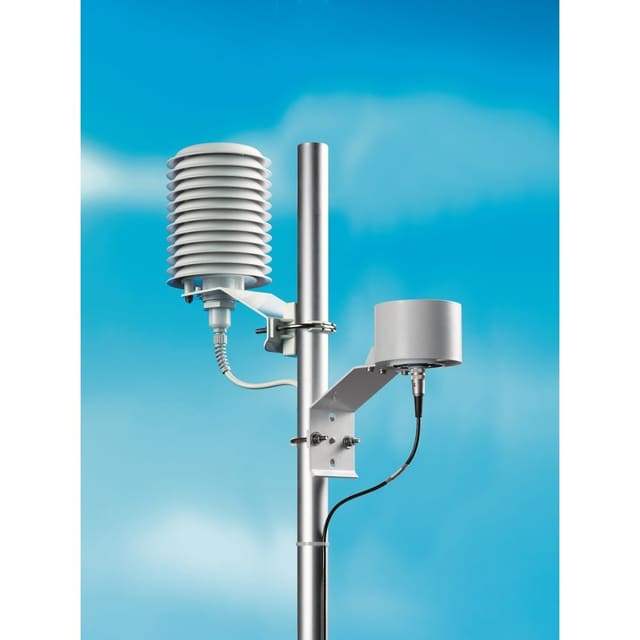
- Capacitive precipitation detector (ref. HD2013.2): event onset/end and wet/dry trigger; guide: capacitive detector.
- Rain gauge with 400 cm² collecting surface (ref. PL400): tipping bucket with 400 cm² orifice.
- Hail sensor (ref. HDI): mechanical hail impact, complementary to radar typing.
- Two-axis ultrasonic anemometer (ref. HD52.3D): wind for radar QC.
- Data logger with 4G module (ref. HD33MT.4): RS485/telemetry in one enclosure.
Checklist before requesting a quote
- Is the experiment question official depth, fast intensity, precip type, or a combination?
- Is the site remote enough that “maintenance-free” outweighs ±10%?
- Will a mechanical rain gauge sit on the same site for intercomparison and QC?
- Does the logger speak ModBus/NMEA/ASCII over RS485 or RS232, with stable 7–30 V?
- Does the solar budget cover ~1.6 W continuous — and are you deliberately avoiding a funnel heater?
- Do wind and temperature enter the same logger to flag doubtful typing and intensity?
- Is hail a damage/impact variable (add a hail sensor) or only a classification?
- Who documents ±10% uncertainty and the daily QC protocol in the metadata?
References
- Hensistemas product sheet for the radar precipitation gauge (ref. EIC-28RS2E): range, ±10%, interfaces, power and dimensions.
- World Meteorological Organization. Guide to Instruments and Methods of Observation (WMO-No. 8), Volume I — Measurement of Meteorological Variables (precipitation chapter; distinction between presence/intensity sensors and quantitative reference gauges).
- Hensistemas. Tipping-bucket rain gauges in research.
- Hensistemas. Weighing rain gauge in research.
- Hensistemas. Capacitive precipitation detector.
- Hensistemas. Wind measurement at the weather station.
- Hensistemas. Data logger: how to choose the right one.
- Hensistemas. Weather station telemetry.
Instruments for this application
EIC-28RS2E
EIC-28RS2E Radar Precipitation Gauge
DeltaOhm - GHM GroupHD2013
HD2013 Tipping Bucket Rain Gauge
DeltaOhm - GHM GroupHD2016
HD2016 – Weighing Rain Gauge
DeltaOhm - GHM GroupHD2013.2
HD2013.2 – Rain Detector
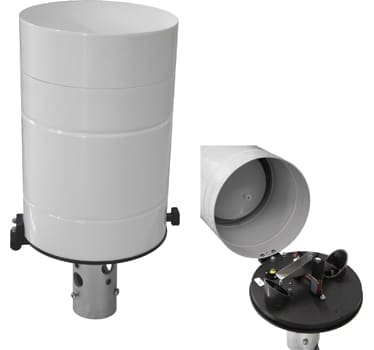
NESASRLPL400
PL400 Rain Gauge with 400cm2 Collecting Surface
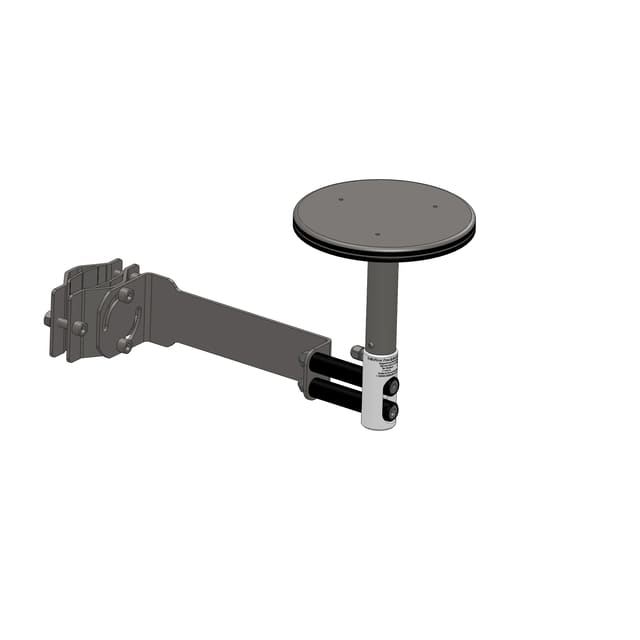
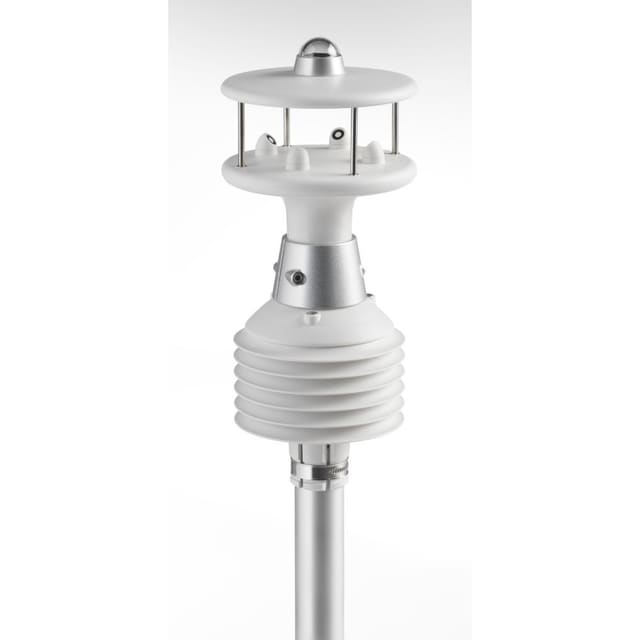
DeltaOhm - GHM GroupHD52.3D
HD52.3D Series – 2-Axis Ultrasonic Anemometer
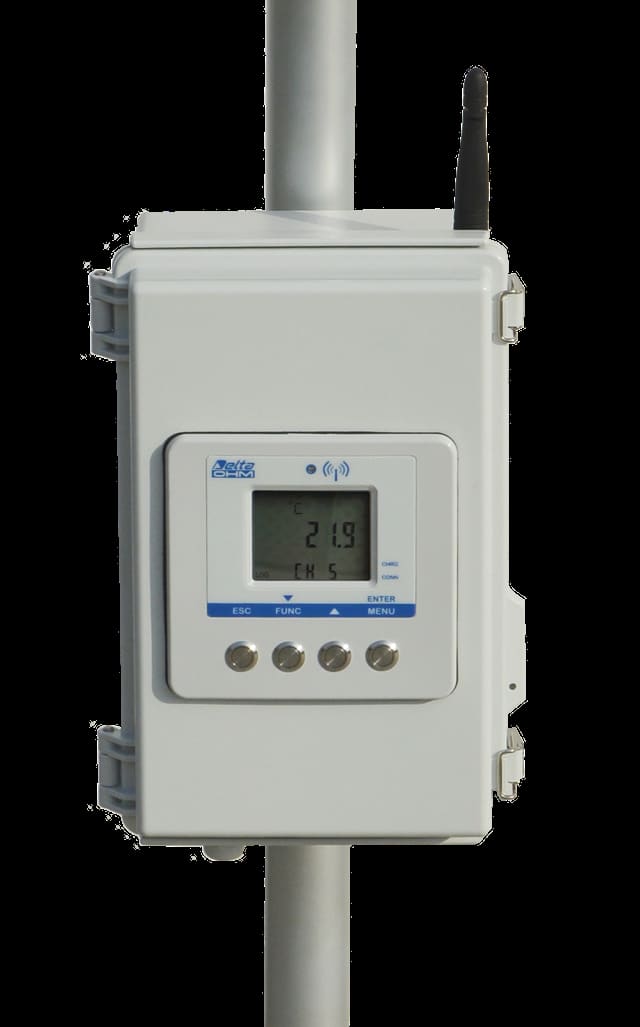
DeltaOhm - GHM GroupHD33MT.4
HD33MT.4 Data Logger for Weather Station
Keep reading
Animal environment in research: how to measure temperature, humidity and black globe in livestock buildings, calculate THI, BGHI and enthalpy and combine them with the weather station
A didactic guide to measuring the thermal environment in poultry houses, dairy barns and paddocks: why a thermometer alone is not enough, black globe temperature, air velocity, the THI, BGHI, radiant heat load and enthalpy indices (with local pressure), choosing a temperature and humidity logger and propagating its error, standard and alternative globes, installation, intercalibration, salt solutions, ammonia, quality control, a worked example, combining with the weather station and applications in Brazilian research.
Silicon-cell pyranometer at the weather station: when it is enough, where the errors come from and how to calibrate it against a thermopile
A didactic guide to silicon photodiode pyranometers at research stations: how they work, why calibration holds for clear skies, spectral error under clouds and in reflected light, cosine response, temperature, dirt on the acrylic diffuser and drift, what ISO 9060:2018 says (Class C, not spectrally flat), when the sensor is enough, field cross-calibration against a thermopile with a clear-sky filter and worked example, the FAO-56 Rso envelope, integration to MJ/m²·day, effect on ET₀, dense low-cost networks and Brazilian references.
Spectral light quality in plant research: how to measure the spectrum with a spectroradiometer under LEDs, coloured shade nets and greenhouses and combine it with weather-station PAR
A didactic guide to measuring spectral light quality in plant research: quantity vs. quality, how a spectroradiometer works, PPFD, ePAR (400–750 nm), band fractions, R:FR ratio and PSS calculated from the spectrum, why lux cannot equalise treatments, Brazilian examples with coloured nets and in vitro LEDs, measurement campaigns, transmittance of nets and vessels, instrument limits and combination with continuous weather-station PAR.