
Meteorology · Agriculture · Technical guides
Capacitive precipitation detector at the weather station: rain onset and end, wet/dry sampling and event QC
A teaching guide to the capacitive precipitation detector in research: detecting rain versus measuring depth, capacitive principle with heater and anti-false-indication dome, ON/OFF (open collector), calibrated 0–1 V and 1.5–6 kHz frequency outputs, about a 2-minute end-of-event delay, mast installation, alumina-element maintenance, pairing with rain gauge, wind and data logger, and use in wet/dry samplers, irrigation and event quality control.
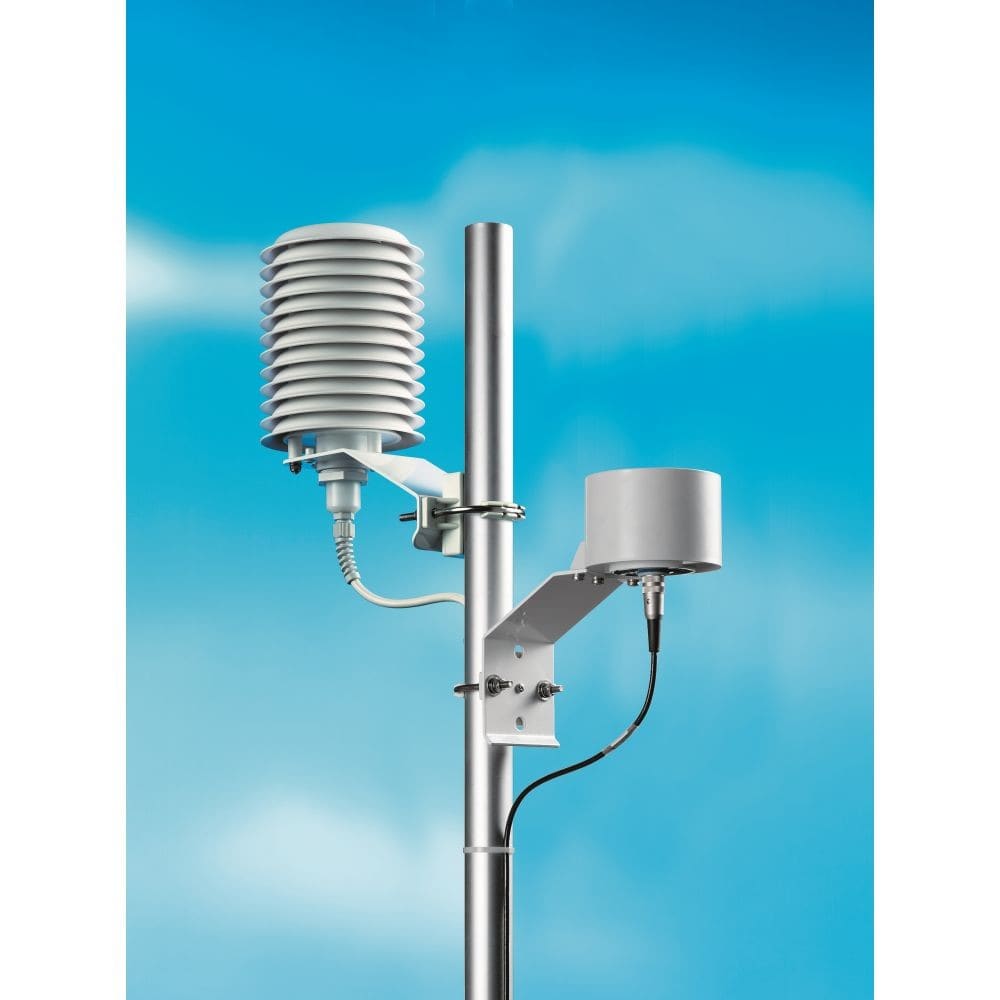
When the research question is "is it raining now?" — not "how many millimeters fell?" — the right instrument is no longer the rain gauge. The tipping-bucket rain gauge and the weighing rain gauge measure the depth — the equivalent height of accumulated water — and, from it, the intensity. With millisecond-scale precision, they do not tell you whether the first drop has already arrived, nor whether the event has truly ended or just eased off for a few seconds.
It is precisely this boundary — the start and end of a precipitation event, rain or snow — that a capacitive precipitation detector was designed to mark. Installed on the same mast as the weather station, it delivers a fast ON/OFF signal, an analog output proportional to the humidity of the sensing surface, and, in some models, a frequency output. The classic use is to trigger wet/dry samplers, pause irrigation, close windows or protection relays, and serve as quality control (QC) for rain gauge records.
This guide is for professors, graduate students, and researchers at universities and public institutes in Brazil. The goal is to explain the capacitive principle, the role of the heater and the dome, what each output is for, when the detector complements (rather than replaces) the rain gauge, and how to cross-reference it with wind and the data logger at the station.
Why the start and end of the event matter
In many experiments, event duration carries as much weight as depth. Concrete examples:
- Average intensity. If the rain gauge accumulates 12 mm and the detector marks 40 minutes of continuous rain, the average intensity is 18 mm/h. Without the start/end marker, the "average" intensity depends on an arbitrary aggregation criterion (5 min, 10 min, full hour) and will mix dry periods into the denominator.
- Wet/dry sampling. In atmospheric deposition studies, the wet collector's lid needs to open at the first sign of rain and close at the end, so as not to mix dry aerosol into the rain sample. The opening and closing delay dominates the sampling error. We cover this in detail in the guide on wet and dry atmospheric deposition.
- Irrigation and erosion. A controller that "sees" rain in real time can interrupt an irrigation cycle and avoid overlap with natural precipitation. In erosion studies, the start of the event defines when runoff begins to be generated on the plot.
- Rain gauge quality control. A tipping bucket that tips without the detector marking rain suggests an insect, vibration, or calibration issue. A detector that marks rain without the tipping bucket tipping suggests very light rain (below the bucket's resolution), poorly captured snow/hail, or a mechanical fault. Cross-referencing the two is a cheap and powerful filter.
In short: the detector answers the binary, temporal question; the rain gauge answers the quantitative question. Together, they close out the picture of the event.
Capacitive principle, heater, and dome
The capacitive detector does not "weigh" water or count drops. The sensing element — typically an electrode on an alumina substrate — forms a capacitor whose capacitance changes as the surface is wetted by drops. The larger the wetted area, the larger the change in signal. In the reference model for this article, the sensing area is 6.6 cm², tilted at 30°, and the minimum sensitive area is 0.05 cm² — enough to register the arrival of small drops without requiring a minimum depth the way a tipping bucket does.
Three design elements set a field detector apart from a "generic" humidity sensor:
- Integrated heater. Keeps the surface dry between events, evaporates residual moisture, and reduces false positives from fog, dew, or condensation. At low temperatures, it melts snow on the sensor and allows detection of solid precipitation that would otherwise sit deposited without wetting the surface. When the station's energy budget is critical (small panel, battery near its limit), the heater can be switched off via a dedicated pin (Heater OFF tied to GND).
- Circular dome. Acts as a windshield around the sensing element: it reduces false indications from lateral splash, wind-carried dust, or drops that would otherwise graze the surface. It is not a collector: water is not accumulated for a depth measurement.
- Tilted geometry. The 30° angle promotes water runoff and speeds up drying after the rain ends, together with the heater.
The detector, therefore, does not replace the rain gauge: it does not deliver millimeters. It delivers a state (rain/dry) and, on the analog and frequency outputs, a relative indication of the intensity of surface wetting.
ON/OFF, 0–1 V, and frequency outputs: what each one is for
A well-specified detector offers three distinct electrical paths, and each fits a particular use:
Rain ON/OFF (open collector)
An open collector output that closes in the presence of rain (or snow melted by the heater). Typical limits: maximum voltage 15 V and maximum current 50 mA. It serves to:
- trigger a wet/dry sampler relay;
- interrupt irrigation;
- close windows, shutters, or plot covers;
- record a "precipitation state" digital channel in the data logger.
When the detector drives a relay coil, the datasheet always recommends a protection diode in parallel with the coil, so as not to destroy the output with the inductive back-voltage.
The delay circuit is the detail that most confuses beginners. The OFF → ON transition (rain onset) is nearly instantaneous: a delay of less than 0.1 ms. The ON → OFF transition ("rain over", end of rain) goes through a delay of about 2 minutes in the product's circuit — and the datasheet also specifies a maximum shut-off of less than 5 minutes. This delay exists on purpose: it distinguishes the true end of the event from a brief lull in light rain. Without it, the sampler would open and close its lid with every drizzle, and the rain gauge's QC would fragment a single event into dozens of "microevents."
In field practice: use the fast ON to open the sampler and the delayed OFF to close it; document the delay in the experiment's metadata.
Analog output 0…1 V (calibrated)
0 V = rain (wetted surface) and 1 V = dry. This is the preferred output when the logger has an analog voltage channel and you want to record not just the state, but a continuous curve of the wetting. Useful for:
- studying the "signature" of event onset and end;
- discriminating persistent light rain from intermittent rain;
- feeding an analog threshold into the logger (for example, treating any value below 0.3 V as rain), in parallel with the ON/OFF.
Frequency output 1.5…6 kHz (uncalibrated)
Varies from about 1.5 kHz (rain) to 6 kHz (dry). It is not calibrated in millimeters — it is a relative indication, useful when the logger counts frequency more easily than it reads voltage, or as a redundant diagnostic channel. Do not use this output as if it were a rain gauge.
Power supply and consumption
Typical power supply 12 Vdc ±10%. Typical consumption about 130 mA, maximum about 230 mA; with the heater off, about 10 mA. Sensor power falls in the range of 0.5 to 2.3 W. At a station with a small solar panel, plan the energy budget considering the heater being on most of the time — and only turn it off if the risk of a false positive from dew/fog is acceptable in your experimental design.
Detector versus tipping-bucket rain gauge versus weighing rain gauge
| Question | Capacitive detector | Tipping bucket | Weighing |
|---|---|---|---|
| Is it raining now? | Yes (fast ON/OFF) | Indirect (only after a tip) | Indirect (after Δmass) |
| How many mm? | No | Yes | Yes |
| Fine intensity / light rain | Relative indication | Limited by bucket resolution | Good at low intensity |
| Snow / solid precipitation | With heater (detects upon melting) | Poor without a heated funnel | Better with a suitable funnel/scale |
| Wet/dry sampling | Ideal as trigger | High delay and threshold | High delay and threshold |
| Event QC | Excellent as a temporal reference | Is the measured variable | Is the measured variable |
Practical rule for project design:
- detector only → automation and temporal QC, without depth;
- rain gauge only → depth and intensity, with detection delay and threshold;
- detector + rain gauge → the standard arrangement for serious research: event timing + quantity.
For the depth measurement itself, see the guides on tipping-bucket rain gauges and weighing rain gauges.
Installation and maintenance
- Location. Away from buildings, trees, and any object above the sensor that could intercept drops or drip onto it. The detector does not tolerate a "ceiling" — an eave or a solar panel above it generates false negatives or delayed dripping.
- Mounting. Bracket for a 30 to 50 mm mast, in horizontal or vertical orientation (the arm usually has dual mounting holes). Height is typically the same as the rain gauge's rim or slightly above it, in the sector least shaded by the mast itself.
- Cable. Standard 5 m cable with an IP68 connector; other lengths available on request. Ground the cable shield and keep the heater ground separate from the electronics ground, for noise immunity.
- Environmental range. Operation typically from −15 to +55 °C; storage from −40 to +65 °C.
- Cleaning. Cotton with distilled water. The element on alumina is fragile: do not use abrasives, aggressive solvents, or hard brushes. In locations with intense marine aerosol, mineral dust, or pollen, set up a weekly or biweekly routine.
- Protection. In fields with birds, an optional spiked ring ("bird spike") is available; request it at order time if the site has a history of birds landing on sensors.
Typical body dimensions: about ø107 × 70 mm, mass on the order of 450 g (per the manufacturer's datasheet). External material is a BASF LURAN S777K-type polymer, suitable for UV exposure and weathering.
Cross-referencing with the weather station
The detector's scientific value emerges when it feeds into the same logger as the rest of the station:
- Rain gauge (tipping bucket or weighing). Digital ON/OFF channel + tip or mass channel. In post-processing, flag events only when both agree; investigate disagreements (insect in the bucket, rain below resolution, heater off under snow).
- Wind. Apparent rain intensity and angle of incidence change with wind. An ultrasonic anemometer on the same mast helps interpret splash and undercatch. See the guide on wind measurement.
- Data logger. The detector typically requires a digital input (ON/OFF), an analog input (0–1 V), and, if applicable, a frequency channel, plus 12 Vdc for power and a digital line for Heater OFF. Station loggers with mixed inputs — such as the data logger with 4G module — accommodate this without workarounds. For logger selection, see the guide on data loggers; for telemetry, see the guide on station telemetry.
A minimal daily QC protocol: (a) are there tips without an ON signal? (b) is there an ON signal without a tip for more than N minutes? (c) has the analog output stayed "stuck" at dry or at rain for days? Any of these three warrants a field visit.
Featured product: capacitive precipitation detector with heating
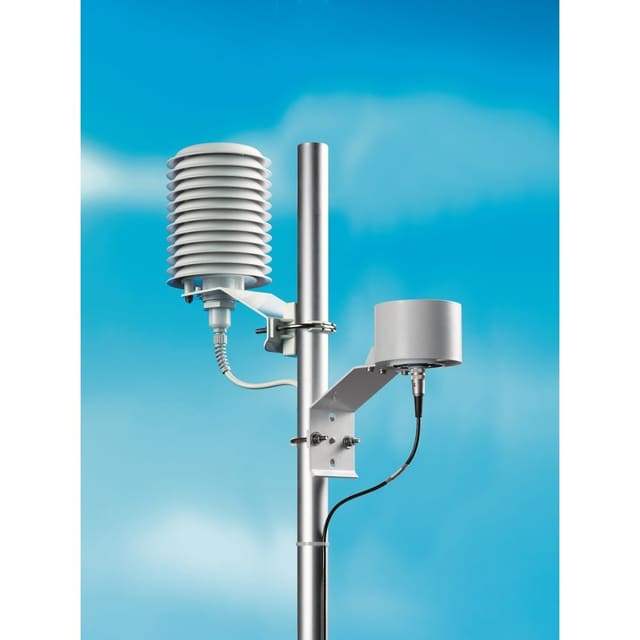
In the Hensistemas catalog, the reference instrument for this role is the capacitive precipitation detector with heating (ref. HD2013.2, Delta OHM / Senseca). Per the manufacturer's datasheet specifications:
- capacitive principle, element on alumina, sensing area 6.6 cm², angle 30°, minimum sensitive area 0.05 cm²;
- integrated heater, with a Heater OFF input (switches off when connected to GND);
- circular dome acting as a windshield against false indications;
- outputs: Rain ON/OFF (open collector, closes with rain; max. 15 V / 50 mA), calibrated analog 0…1 V (0 V = rain, 1 V = dry), and uncalibrated frequency 1.5…6 kHz;
- OFF→ON delay < 0.1 ms; ON→OFF delay ("rain over") on the order of 2 min in the product's circuit (shut-off < 5 min per the datasheet);
- power supply 12 Vdc ±10%; typ. consumption 130 mA, max. 230 mA; 10 mA with the heater off; sensor power 0.5…2.3 W;
- dimensions ø107 × 70 mm, mass about 450 g, 5 m cable, BASF LURAN S777K material;
- operation −15…+55 °C, storage −40…+65 °C;
- mast mounting 30–50 mm (horizontal or vertical).
For researchers, the strong points are the fast response at event onset, the deliberate delay at the end (which avoids "whipsawing" samplers), and the three outputs coexisting in the same housing. The point to plan for is the heater's consumption in the solar budget and the fragility of the sensing element during routine cleaning.
Alternatives and complements from the catalog
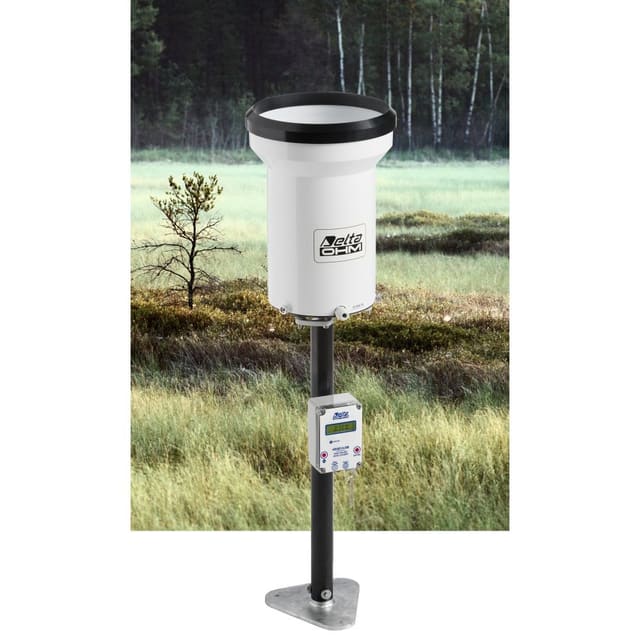
- Tipping-bucket rain gauge (ref. HD2013): the classic measurement of depth and intensity by tipping; combine with the detector for temporal QC. Guide: tipping-bucket rain gauges in research.
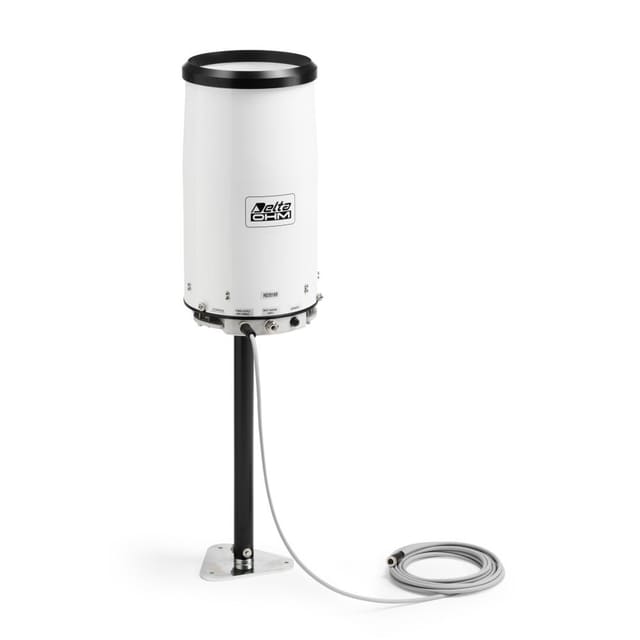
- Weighing rain gauge (ref. HD2016): load cell for low intensity and solid precipitation; guide at weighing rain gauges.
- Rain gauge with 400 cm² collecting surface (ref. PL400): a tipping-bucket alternative with a standardized 400 cm² collecting area.
- Wet/dry passive sampler (deposition gauge): the use case in which the detector (or the sampler's own rain sensor) decides lid opening and closing. Guide: wet and dry atmospheric deposition.
- Two-axis ultrasonic anemometer (ref. HD52.3D): wind on the same mast, to interpret splash and undercatch.
- Data logger with 4G module for weather station (ref. HD33MT.4): digital inputs, analog inputs, and cellular telemetry in the same unit.
- Housing with acquisition system for weather stations (ref. HD32.35): a cabinet option when the station needs more channels and mechanical protection.
Checklist before budgeting
- Is the experiment's question event state (start/end), depth, or both?
- Will there be a wet/dry sampler, automated irrigation, or a protection relay that depends on the ON/OFF signal?
- Does the logger have a digital input, an analog 0–1 V input, and, if needed, a frequency input, plus 12 Vdc?
- Does the solar budget accommodate ~0.5 to 2.3 W continuous draw from the heater, or will Heater OFF need to be switched?
- Does the site experience frequent fog, dew, or snow — cases where the heater is not optional?
- Will the rain gauge (tipping bucket or weighing) be installed on the same mast/area for cross-QC?
- Who will perform cleaning of the sensing element, how often, and with distilled water?
- Is there a risk of birds landing on the sensor (consider a bird spike at order time)?
References
- Delta OHM / Senseca. HD2013.2 Rain Detector (technical datasheet; sensor specifications, outputs, delay, and power supply).
- World Meteorological Organization. Guide to Instruments and Methods of Observation (WMO-No. 8), Volume I — Measurement of Meteorological Variables, precipitation chapter (discussion of present/absent precipitation detectors and their distinction from quantitative rain gauges).
- HenSistemas. Tipping-bucket rain gauges in research.
- HenSistemas. Weighing rain gauges in research.
- HenSistemas. Wet and dry atmospheric deposition in research.
- HenSistemas. Wind measurement at the weather station.
- HenSistemas. Data logger: how to choose the right one.
- HenSistemas. Telemetry at the weather station.
Instruments for this application
DeltaOhm - GHM GroupHD2013.2
HD2013.2 – Rain Detector
DeltaOhm - GHM GroupHD2013
HD2013 Tipping Bucket Rain Gauge
DeltaOhm - GHM GroupHD2016
HD2016 – Weighing Rain Gauge
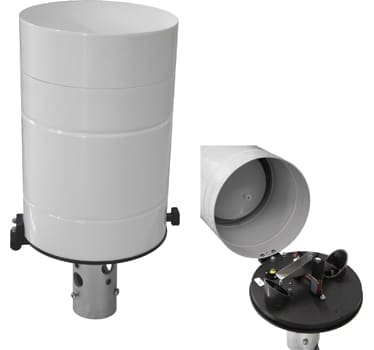
NESASRLPL400
PL400 Rain Gauge with 400cm2 Collecting Surface
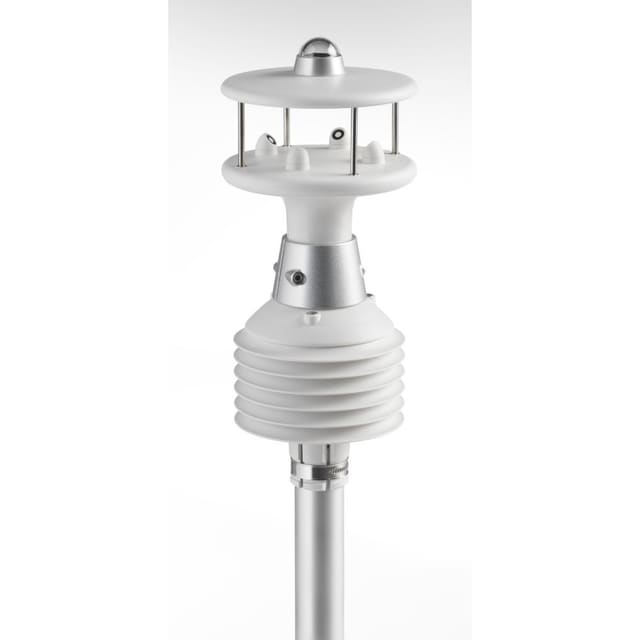
DeltaOhm - GHM GroupHD52.3D
HD52.3D Series – 2-Axis Ultrasonic Anemometer
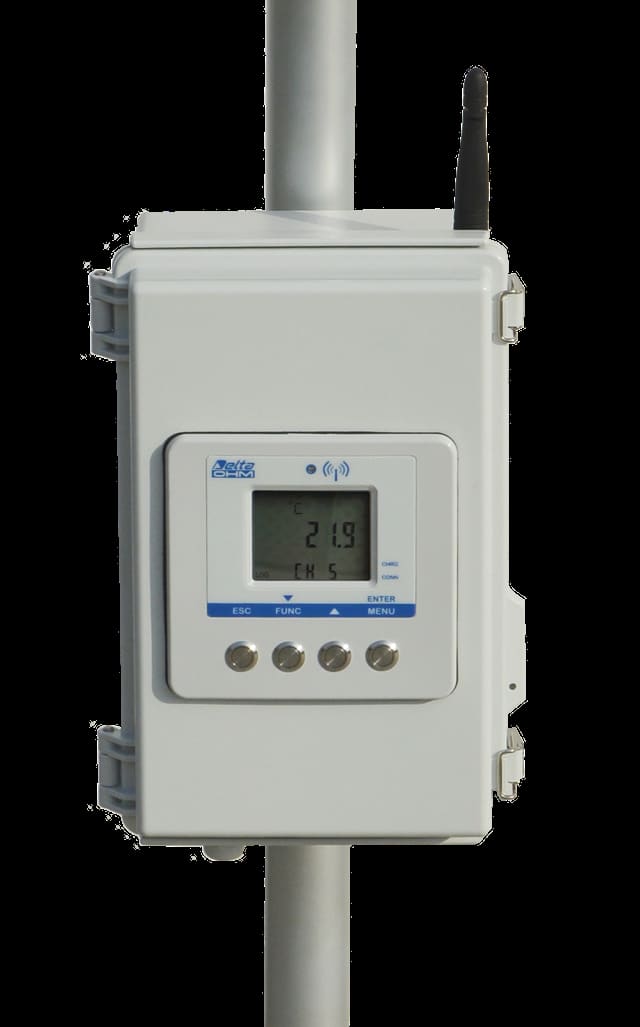
DeltaOhm - GHM GroupHD33MT.4
HD33MT.4 Data Logger for Weather Station
Keep reading
Animal environment in research: how to measure temperature, humidity and black globe in livestock buildings, calculate THI, BGHI and enthalpy and combine them with the weather station
A didactic guide to measuring the thermal environment in poultry houses, dairy barns and paddocks: why a thermometer alone is not enough, black globe temperature, air velocity, the THI, BGHI, radiant heat load and enthalpy indices (with local pressure), choosing a temperature and humidity logger and propagating its error, standard and alternative globes, installation, intercalibration, salt solutions, ammonia, quality control, a worked example, combining with the weather station and applications in Brazilian research.
Silicon-cell pyranometer at the weather station: when it is enough, where the errors come from and how to calibrate it against a thermopile
A didactic guide to silicon photodiode pyranometers at research stations: how they work, why calibration holds for clear skies, spectral error under clouds and in reflected light, cosine response, temperature, dirt on the acrylic diffuser and drift, what ISO 9060:2018 says (Class C, not spectrally flat), when the sensor is enough, field cross-calibration against a thermopile with a clear-sky filter and worked example, the FAO-56 Rso envelope, integration to MJ/m²·day, effect on ET₀, dense low-cost networks and Brazilian references.
Spectral light quality in plant research: how to measure the spectrum with a spectroradiometer under LEDs, coloured shade nets and greenhouses and combine it with weather-station PAR
A didactic guide to measuring spectral light quality in plant research: quantity vs. quality, how a spectroradiometer works, PPFD, ePAR (400–750 nm), band fractions, R:FR ratio and PSS calculated from the spectrum, why lux cannot equalise treatments, Brazilian examples with coloured nets and in vitro LEDs, measurement campaigns, transmittance of nets and vessels, instrument limits and combination with continuous weather-station PAR.