
Meteorology · Agriculture · Technical guides
Weather station telemetry: how to choose between cellular, LoRaWAN and satellite without losing research data
A teaching guide to weather station telemetry: WMO recommendations, the INMET example, layers of the data chain, SDI-12, 4G cellular, LoRaWAN and satellite, radio link physics, power budget, UTC clock, data integrity, installation and quality control.
A research weather station is only worth what reaches the database. Well-chosen, well-installed and well-calibrated sensors cannot save a series with three-week gaps because the battery ran out and nobody noticed, because the data SIM was blocked, or because the logger clock drifted until it was ten minutes fast. Telemetry, the automatic transmission of data from the field to the lab, turns a station that is visited every two months into a station that is followed every day.
This guide is for lecturers, graduate students and researchers at public universities and institutes who are setting up or upgrading an experimental site. We explain what the WMO recommends, how INMET solves the problem in the Brazilian national network, the layers of a telemetry chain, how to compare cellular, LoRaWAN, satellite and local networks, the basic physics of a radio link, the power budget, the clock, data integrity, installation, maintenance and quality control. For choosing the logger itself (inputs, memory, accuracy), see our guide Data logger: how to choose the right one first.
What the WMO says about automatic stations and transmission
The World Meteorological Organization Guide to Instruments and Methods of Observation (WMO-No. 8), in the chapter on measurements at automatic weather stations (Volume III, chapter 1, in recent editions), defines an automatic weather station as a meteorological station at which observations are made and transmitted automatically. Transmission is therefore part of the definition. Four ideas from the same chapter guide this text:
- No transmission medium is universally superior. The most suitable one depends on the site and on what is available there, and sometimes the chain combines more than one medium.
- Communication can be one-way or two-way. One-way, the station only sends; two-way, it also receives commands, so you can reconfigure it, request data to be resent and set the clock remotely.
- The real-time clock is an essential part of data processing. It must keep time even during power outages, and clock accuracy needs special attention because readings, sampling intervals and time stamps depend on it. Some stations synchronize the clock with time reference signals or GPS.
- Power drives the design. The Guide recommends considering 12 V DC supply, with a float-charged battery where mains power exists, and notes that remote sites rely on batteries charged by solar panels or another source. If the station depends on mains power, there should be backup at least for the clock, the processor and the volatile memory holding recent data.
How the national network solves the problem
INMET, Brazil's national weather service, is a good example of scale. According to a technical note on its automatic station network, each station samples the variables every minute; every hour the data are aggregated and transmitted to headquarters in Brasília by satellite or by cellular phone, go through quality control and are stored in a database. Historically the institute used a two-way geostationary satellite system and, where cellular coverage is reliable, cellular transmission at scheduled times. A 2024 terms of reference from the Ministry of Agriculture for the network calls for two-way communication by 3G, 4G or newer cellular and by satellite, with a supervisory system to monitor the transmission equipment itself.
Two lessons for an experimental site: the national network combines media according to the site, and it monitors telemetry as an instrument, not as an accessory. In the Brazilian hydrology literature, guidelines for automatic and telemetric networks published in the Revista Brasileira de Recursos Hídricos (2007) already pointed to transmission frequency as the bottleneck of satellite networks and to cellular telephony as a low-cost alternative where there is signal.
The layers of a telemetry chain
It helps to think of telemetry in layers, because each has its own failure modes:
- Sensor → logger. Analogue signal (voltage, 4–20 mA current, Pt100), pulse counting (rain gauge, cup anemometer) or digital bus (SDI-12, RS485 Modbus).
- Logger. Measures, computes averages and totals, applies the time stamp and writes to local memory.
- Link. Cellular modem, LoRaWAN radio, satellite transceiver, Wi-Fi or Ethernet.
- Server. Receives via FTP, HTTP, e-mail or a proprietary protocol and writes to a database.
- Processing. Quality control, alarms, dashboards and export for analysis.
The most important principle in this whole text is this: the logger memory is the primary source; what arrives by telemetry is a copy. A good chain works as store-and-forward: if the link drops, the logger keeps recording and, when the link comes back, the late data are recovered. Be wary of any architecture in which the sensor transmits directly with no local copy, because every lost packet is a datum lost forever.
The sensor layer: analogue, SDI-12 or RS485
The sensor interface affects telemetry because it determines how much cable, power and configuration the station needs.
- Analogue. Simple and universal, but low-voltage signals suffer from noise and drop on long cables, and each sensor takes one channel.
- SDI-12. An open serial-digital interface standard at 1200 baud, with three conductors (data, ground and 12 V). Each sensor has a one-character address: "0" to "9" are mandatory, with upper- and lower-case letters available for more sensors. The specification (version 1.4) guarantees at least 10 sensors on the bus, each with about 60 m (200 ft) of cable; with fewer sensors, longer cables are possible. Because the sensor delivers the value already in engineering units, the logger does not need to convert an electrical signal.
- RS485 Modbus-RTU. A faster differential bus that supports cables hundreds of metres long and is common in industrial and ultrasonic sensors.
In practice, digital sensors simplify the station: fewer channels, fewer cables and remote diagnostics (many SDI-12 sensors report errors and serial numbers). The price is learning the protocol and documenting each sensor's address.
The transmission media, one by one
Cellular (4G)
The most common medium at sites with coverage. It allows short intervals, two-way communication, delivery via FTP, HTTP or e-mail and SMS alarms. It costs a data plan per station and draws power in peaks during the connection.
Pay attention to how networks are evolving in Brazil. Since 6 April 2025 Anatel, the telecom regulator, only certifies phones and access terminals compatible with at least 4G, and operators have been switching off 2G and 3G networks gradually, with no single national date; the market expects shutdowns by the end of this decade. For a station meant to run for years, choose a 4G modem and confirm with the supplier the supported LTE bands and compatibility with the operator that has the best signal at the site. Before buying, take a phone from the chosen operator to the exact installation point, at antenna height, and record the signal strength at different times of day.
LoRaWAN
LoRaWAN is a long-range, low-power network: devices send short messages to a gateway, which forwards them over the internet to a network server. It is ideal for many nearby points, such as a network of soil and microclimate sensors on an experimental farm or in a small catchment, because a single internet-connected gateway serves dozens of battery-powered nodes for years.
In Brazil, the channel plan indicated by the LoRa Alliance (Regional Parameters document) is AU915-928, in the 915 to 928 MHz band. A device configured for the European (EU868) or North American (US915) plan will not talk to a Brazilian gateway, so check the frequency plan when buying. LoRaWAN messages are small (from tens to a few hundred bytes, depending on the data rate) and transmission intervals are usually minutes, not seconds. A LoRaWAN node should therefore store data locally and send only what is needed.
Satellite
Where there is neither cellular coverage nor a gateway, as in parts of the Amazon, the Pantanal, the semi-arid Northeast or on islands, satellite is the solution. Low-orbit constellations such as Iridium provide global coverage with small antennas; geostationary systems require antenna pointing. Costs per message are high and messages are small: in Iridium's Short Burst Data (SBD) service, for example, transceivers such as the 9602 accept mobile-originated messages of up to 340 bytes.
That limit changes how you think about the data. A text line such as 2026-10-27T12:00Z;23.4;85.2;1012.3;0.0;3.2;145;612 is about 50 bytes; six records per hour in text exceed 300 bytes. The same six records, with 10 variables encoded as 16-bit integers (for example, temperature in tenths of a degree), take 6 × 10 × 2 = 120 bytes, plus a header with ID, time and battery voltage. In satellite telemetry, message format is part of the scientific design: decide in advance which variables and statistics are essential in real time and which can wait for the memory download.
Local networks: Wi-Fi, Ethernet and proprietary radio
On university campuses, greenhouses and stations next to a building, Ethernet or Wi-Fi do the job with zero recurring cost. Proprietary radio systems, with a base unit and repeaters, cover a building or a group of greenhouses. They are excellent for monitoring environments but require someone to maintain the network and the computer that receives the data.
Quick comparison
| Criterion | 4G cellular | LoRaWAN | Satellite | Wi-Fi/Ethernet |
|---|---|---|---|---|
| Where it makes sense | Site with coverage | Many points within a few km | Remote site without coverage | Campus, building, greenhouse |
| Own infrastructure | None (operator) | Internet-connected gateway | None (provider) | Local network |
| Recurring cost | Data plan | Low or none (own network) | High, per message or volume | None |
| Data volume | High | Low | Low | High |
| Power | Peaks during connection | Very low | Peaks during transmission | Depends on equipment |
| Two-way | Yes | Limited | Depends on service | Yes |
The physics of a radio link
Even without being a telecom engineer, a researcher gains a lot from two calculations.
Free-space path loss. The power of a radio signal falls with the square of distance. In decibels, with distance d in kilometres and frequency f in megahertz:
FSPL (dB) = 20·log₁₀(d) + 20·log₁₀(f) + 32.44
At 915 MHz (the LoRaWAN band in Brazil), the loss is about 105.7 dB at 5 km and 111.7 dB at 10 km: every time the distance doubles, 6 dB are lost, i.e. a quarter of the power arrives. Vegetation, terrain and buildings add further losses, which is why real range is well below the line-of-sight range quoted in brochures.
Fresnel zone. For a link to work well, it is not enough to "see" the other antenna: an ellipsoidal region around the line of sight must be clear. The radius of the first Fresnel zone, with distances in km, frequency in GHz and result in metres, is:
r = 17.32 · √(d₁·d₂ / (f·D))
On a 5 km link at 915 MHz, the radius at mid-path is about 20 m; the rule of thumb of keeping at least 60% of that zone clear requires some 12 m of clearance above trees and terrain. Even on a 1 km link, the mid-path radius exceeds 9 m. This explains why raising the gateway antenna often solves more than replacing equipment, and why a link that works in winter may degrade when vegetation grows or when the tree canopy is wet.
For low-orbit satellites the logic is different: the antenna needs a wide view of the sky, without buildings, hills or trees taking up much of the horizon.
The power budget
At most remote sites, telemetry is the station's largest consumer, and lack of power is the main cause of gaps. The calculation is simple and should be done before buying.
Example 1: logger with a 4G modem. According to the datasheet of the logger we use as an example in this guide, consumption at 12 V is below 3 mA with no network activity and no Ethernet module, with peaks below 1 A during cellular communication. Assume, for illustration only, one connection per hour averaging 250 mA for 60 s, and sensors totalling 40 mAh per day:
- sleep: 3 mA × 24 h = 72 mAh/day;
- transmissions: 24 × (250 mA × 60 s ÷ 3600) ≈ 100 mAh/day;
- sensors: 40 mAh/day;
- total: about 212 mAh/day, or 2.5 Wh per day at 12 V.
With the optional 12 V / 3.4 Ah battery, using only half its capacity to preserve a lead-acid battery, about 1.7 Ah remain, or 8 days without sun. Transmitting every 10 minutes instead of every hour would multiply the transmission share by six. The transmission figures are hypothetical: measure real consumption with a multimeter in series, under your site's signal, because a weak signal lengthens connections.
Example 2: satellite station. The datasheet of the satellite station in the catalogue gives 13 mA in sleep mode and 130 mA average during transmission, with a 12 V / 7 Ah battery. Assuming one message per hour with 40 s of transmission: sleep uses 312 mAh/day and transmission about 35 mAh/day. The lesson is counter-intuitive: here the sleep current rules, not the radio. When comparing equipment, look at both lines of the datasheet.
Solar panel. Divide the daily energy by the number of peak sun hours in the worst month at your site (the Brazilian Solar Energy Atlas, by INPE, helps with this estimate) and by an overall efficiency of 0.6 to 0.7, covering controller, battery, temperature and soiling losses. Then add margin to recharge the battery after a run of cloudy days. For the 2.5 Wh/day of example 1, the calculation gives a few watts; a 10 to 20 W panel leaves room for recharging and battery ageing. In Brazil, tilt the panel towards the north, at an angle close to the site latitude, and keep it clean.
Clock, time zone and time stamp
Data from a network are only comparable if time is the same for all. Three rules:
- Use UTC in the logger and in the database. It is the convention in operational meteorology, and INMET publishes its data in UTC. Conversion to local time (Brasília, UTC−3) is done at presentation, never in the series.
- Document the time-stamp convention. Is the value stamped 12:00 the average from 11:50 to 12:00 or from 12:00 to 12:10? Most loggers stamp the end of the interval, but confirm it and write it in the metadata.
- Synchronize the clock. A clock drifting ±2 ppm accumulates up to about 5 s per month; at ±5 ppm, some 13 s per month. It seems small, but without synchronization the error grows year after year, and fast events, such as a gust or the onset of heavy rain, are shifted relative to other stations. With two-way telemetry, automatic synchronization with a reference server solves the problem.
Data integrity: how to know nothing was lost
Good telemetry is not the kind that never fails; it is the kind that makes it clear when it failed and allows recovery. Features and practices worth their weight in gold:
- Recovery of late data. The logger should resend what was pending when the link returns, or let the server request data for a period.
- Sequence number or unique time stamp per record. Allows duplicates and gaps to be detected automatically.
- Completeness index. Compute, per day and per variable, the fraction of expected records that arrived. A series with 97% completeness and documented gaps is far more useful than one with 99% and unknown gaps.
- Memory sized for the worst case. Work out how long the memory lasts without a download: records per day × number of variables against the datasheet capacity. Also know whether, when full, it overwrites the oldest data or stops recording.
- Periodic physical download. Even with telemetry, download the full memory on every visit and compare it with the database.
- Security. Change factory passwords, prefer encrypted connections when the equipment allows, and do not use e-mail as the only archive of the data.
Installation: antenna, cables, enclosure and lightning
- Antenna. Mount it high on the mast, away from metal parts and other sensors, with the shortest possible cable: every metre of thin coaxial cable adds losses.
- Enclosure. The logger and battery go in an enclosure with a suitable protection rating (IP65 or higher), sealed cable glands, desiccant and, preferably, shade from direct sun, because the internal temperature of an exposed box easily exceeds air temperature and shortens battery life.
- Grounding and surges. Brazil has one of the highest lightning incidences in the world, according to INPE's Atmospheric Electricity Group (ELAT). Ground the mast, use surge protectors on the antenna, power supply and long sensor lines, and follow each manufacturer's recommendations.
- Organization. Label each cable with its SDI-12 address or channel, photograph the wiring and keep the photos with the metadata.
Maintenance and quality control of the telemetry itself
Treat the transmission chain as one more station instrument, with its own diagnostic variables:
- Battery voltage and panel voltage in every record: a slow decline over weeks reveals a dirty panel, an ageing battery or higher-than-expected consumption.
- Signal strength (RSSI) and number of connection attempts.
- Internal enclosure temperature.
- Latency between the record time and its arrival time at the server.
Set up simple alarms: a station that has not transmitted for two windows, battery below a threshold, clock off by more than a few seconds. Then apply the usual quality control to the meteorological data: physical limits, temporal consistency (impossible jumps), persistence (value frozen for hours) and comparison with neighbouring stations, such as INMET's. Log every visit, battery change, configuration change and firmware update in the field notebook.
How telemetry changes research
- Near-real-time alerts. Frost, heat stress, heavy rain or a rising river are no longer discovered weeks later.
- Dense networks. With LoRaWAN, dozens of low-cost points in a catchment or field trial reveal gradients that a single station cannot.
- Remote sites followed daily. A station in the forest, visited twice a year, starts warning when something goes wrong, and the next trip carries the right spare part.
- Fewer trips, more data. The cost of a data plan is usually lower than that of a single lost field campaign.
The catalogue's 4G-modem logger
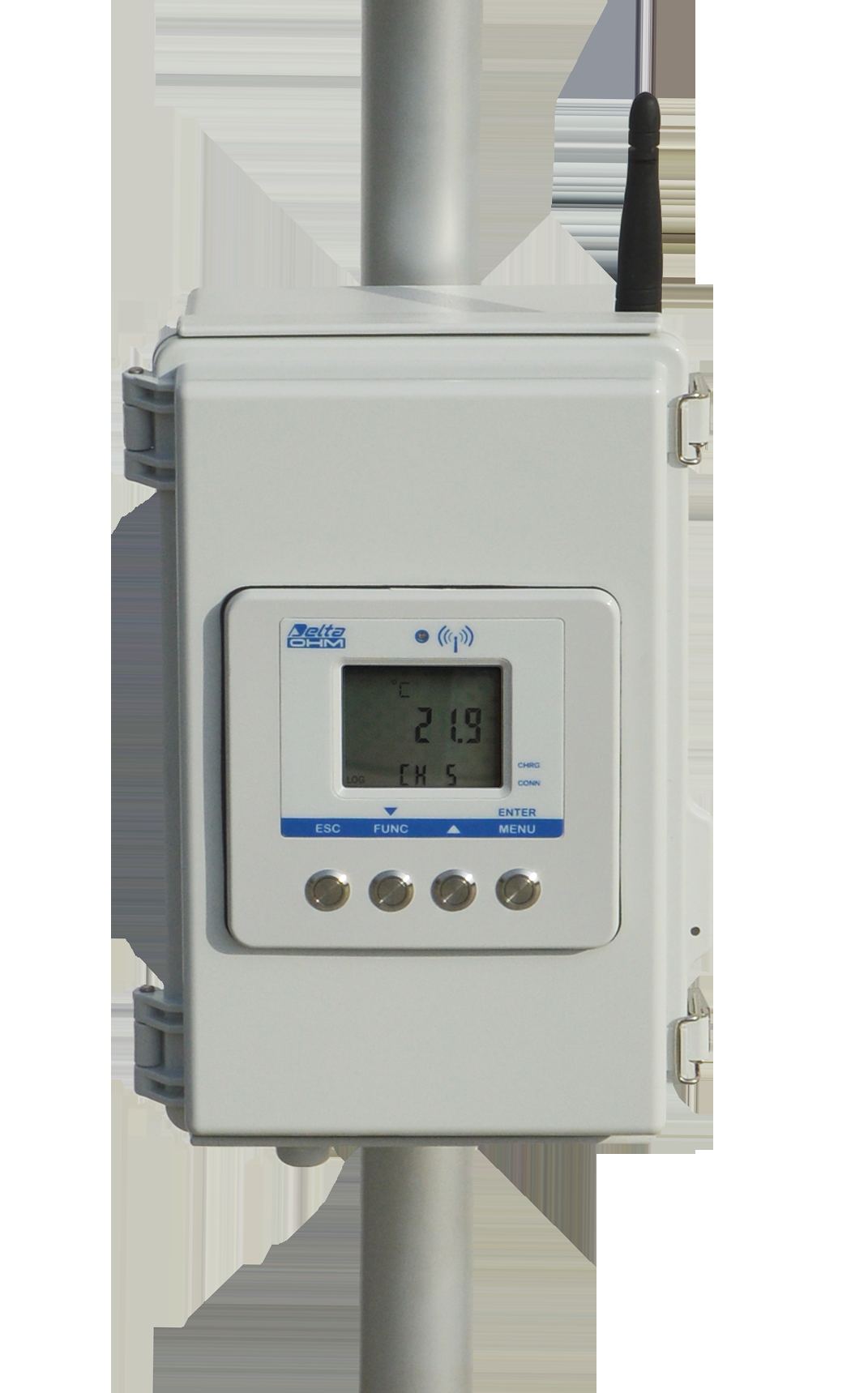
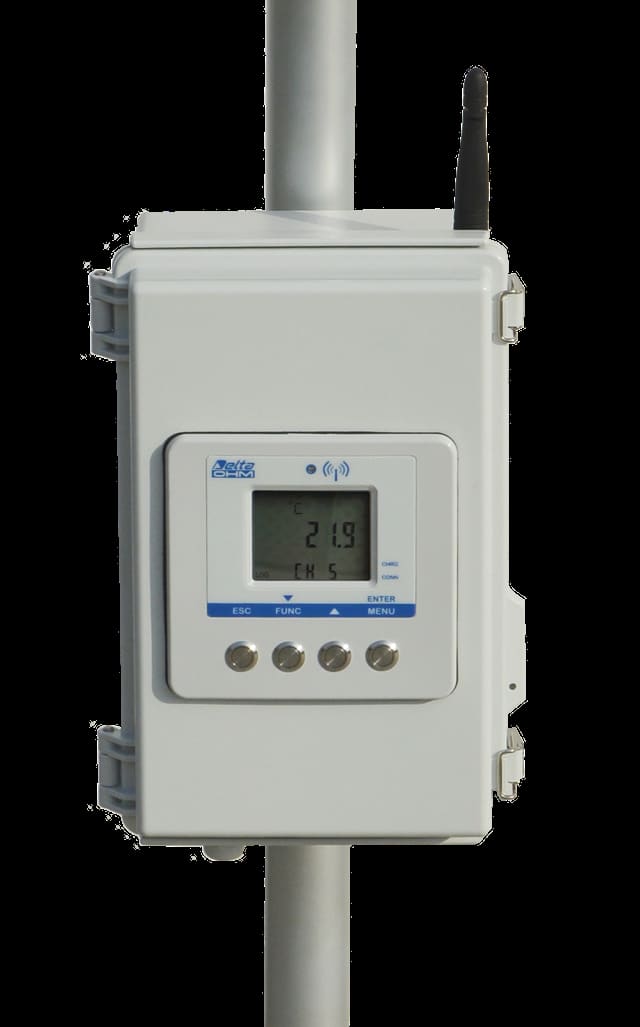
As a concrete example of a logger designed for a weather station with cellular telemetry, the catalogue offers the data logger for weather stations with a 4G module (HD33MT.4, by Delta OHM, now under the Senseca brand). According to the product page and the manufacturer's datasheet:
- 4 analogue inputs configurable one by one (0–50 mV, ±50 mV, 0–1 V, 0–10 V, 0/4–20 mA, Pt100, Pt1000, thermocouple, potentiometer or pyrgeometer), 2 counting inputs for voltage-free contacts (a tipping-bucket rain gauge and a cup anemometer, for example), 1 RS485 port with Modbus-RTU (master or slave) and 1 SDI-12 master port, compatible with protocol version 1.3;
- 4G/3G/GSM(2G)/GPRS cellular module, sending data by e-mail, FTP or to an HTTP server (such as the manufacturer's cloud), remote commands by SMS or TCP/IP connection and alarms by e-mail and SMS, with two thresholds, hysteresis and delay per quantity, plus two contact outputs;
- internal memory, circular or stop-when-full, from 242,850 to 858,070 samples depending on the number of quantities; measurement and logging intervals from 1 s to 60 min;
- clock with ±2 ppm drift (0 to 40 °C) and ±5 ppm (−40 to +70 °C), and automatic time synchronization with a reference server. The product page mentions an HTTP server; the manufacturer's current datasheet mentions HTTP or NTP. Confirm for your firmware version;
- consumption at 12 V below 3 mA with no network activity and no Ethernet module, peaks below 1 A during communication; optional internal 12 V / 3.4 Ah battery with built-in charger and solar panel input; the manufacturer states the logger can run for weeks without recharging, depending on the sensors;
- IP65 polycarbonate enclosure, 270 × 170 × 110 mm, for a 40 mm mast, operating from −40 to +70 °C in the version without display; optional Ethernet module with Modbus TCP/IP;
- free configuration and download software, with an option for FDA 21 CFR Part 11 compliance. SIM card, battery, probes and USB cable are ordered separately.
For an experimental site, the strong point is combining in one box the interfaces of a complete station (analogue, pulses, SDI-12 and Modbus) and the modem, with local logging and automatic delivery. Confirm with the supplier the LTE bands supported for your operator.
Alternatives and complements in the catalogue
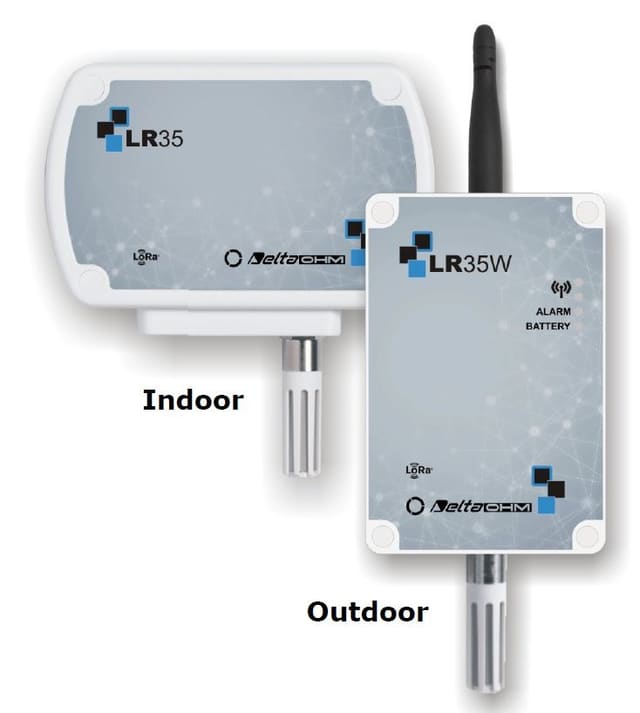
- IoT data loggers for LoRaWAN networks (LR35): log locally and transmit over LoRaWAN, with the AU915 plan among the options, AES128 encryption, transmission intervals from 2 min and battery life of 1.5 to 4 years, depending on the model and configuration given in the datasheet. There are IP67 models for pyranometers, rain gauges and soil moisture and for sensors with 4–20 mA, 0–10 V or Modbus-RTU output. Good for dense networks around a gateway.
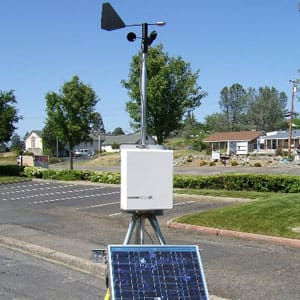
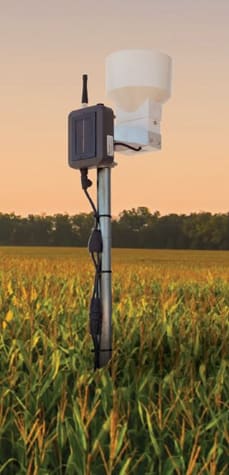
- Satellite weather station (14110-WS-HS-SAT): Iridium satellite module, 4 analogue inputs, pulse and frequency inputs for rain and wind, programmable intervals and event reports, with 13 mA in sleep mode and a 12 V / 7 Ah battery. For sites without cellular coverage.
- Cellular logger for SDI-12 probes (HS14GS-SDI12): IP68 enclosure and connector, solar power with up to 30 days of reserve depending on the battery, 3G/4G SIM, GPS and Wi-Fi for diagnostics and configuration. Practical for a point with a few SDI-12 sensors, such as water level or a soil profile.
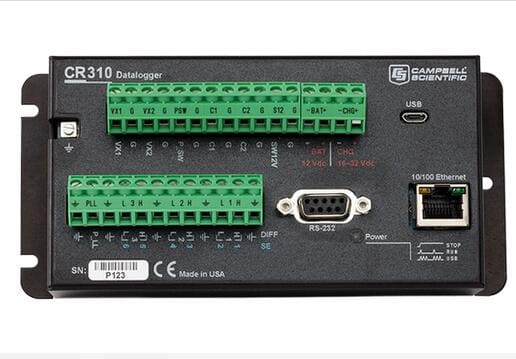
- Programmable logger with Ethernet and Wi-Fi (CR310-WiFi, Campbell Scientific): 24-bit analogue inputs, SDI-12, RS-232, solar charge regulator and protocols such as Modbus, DNP3 and PakBus; accepts cellular and satellite peripherals. Suited when the measurement logic must be programmed.
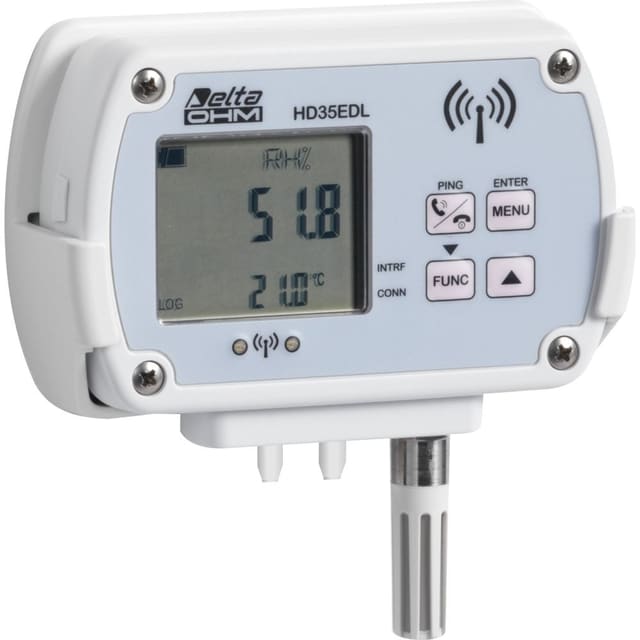
- Wireless data logging system (HD35): radio loggers with a base unit and repeaters, for temperature, humidity, radiation, rain, wind, leaf wetness and soil moisture, among other quantities. Suitable for greenhouses and campuses.
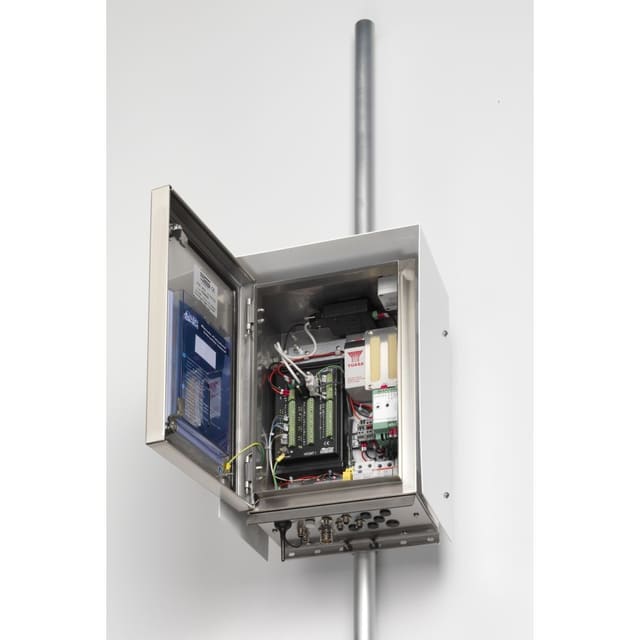
- Enclosure with acquisition system for weather stations (HD32.35): IP66 stainless steel enclosure with a solar radiation shield, supplied wired and tested, with a solar panel version. Protects electronics and battery from direct sun.
Checklist before requesting a quote
- What is the research question and what latency does it require: minutes, hours or days?
- How many points, and how far apart?
- What is the cellular coverage measured at the exact antenna point, and from which operator?
- Which sensors and interfaces (analogue, pulse, SDI-12, Modbus) will the station have?
- What is the daily power budget, and how many sunless days must the station survive?
- What is the data volume per transmission and the acceptable recurring cost?
- Where will the server, database and quality control live, and who looks after them?
- How will grounding, surge protection and maintenance visits be handled?
References
- WMO. Guide to Instruments and Methods of Observation (WMO-No. 8), Volume III: Observing Systems, chapter 1, Measurements at automatic weather stations. Geneva, 2023–2024 editions.
- INMET. Rede de Estações Meteorológicas Automáticas do INMET. Technical note.
- Brazilian Ministry of Agriculture and Livestock. Terms of Reference 61/2024: data communication service for INMET weather stations.
- Diretrizes para redes automáticas e telemétricas de superfície. Revista Brasileira de Recursos Hídricos, 12(4), 225–240, 2007. DOI: 10.21168/rbrh.v12n4.p225-240.
- SDI-12 Support Group. SDI-12: A Serial-Digital Interface Standard for Microprocessor-Based Sensors, version 1.4.
- LoRa Alliance. RP002 LoRaWAN Regional Parameters (AU915-928 plan and country reference table).
- Anatel. Requirement of 4G or newer compatibility for certification of phones and access terminals, 2025.
- Iridium. 9602 SBD Transceiver Product Developer's Guide.
- INPE. Atlas Brasileiro de Energia Solar, 2nd ed., 2017.
- Delta OHM / Senseca. HD33[L]MT.4: data logger for weather station, technical datasheet.
Instruments for this application
DeltaOhm - GHM GroupHD33MT.4
HD33MT.4 Data Logger for Weather Station
DeltaOhm - GHM GroupLR35
LR35 IoT Data Loggers for LoRaWAN Networks
HenSistemas14110-WS-HS-SAT
14110-WS-HS-SAT Satellite Weather Station
HenSistemasHS14GS-SDI12
HS14GS-SDI12 SDI-12 Telemetry Data Logger
Campbell ScientificCR310-WiFi
CR310-WiFi Datalogger with Ethernet
DeltaOhm - GHM GroupHD35
HD35 Wireless Data Logger System
DeltaOhm - GHM GroupHD32.35
HD32.35 Housing with Acquisition System for Weather Stations
Keep reading
Animal environment in research: how to measure temperature, humidity and black globe in livestock buildings, calculate THI, BGHI and enthalpy and combine them with the weather station
A didactic guide to measuring the thermal environment in poultry houses, dairy barns and paddocks: why a thermometer alone is not enough, black globe temperature, air velocity, the THI, BGHI, radiant heat load and enthalpy indices (with local pressure), choosing a temperature and humidity logger and propagating its error, standard and alternative globes, installation, intercalibration, salt solutions, ammonia, quality control, a worked example, combining with the weather station and applications in Brazilian research.
Silicon-cell pyranometer at the weather station: when it is enough, where the errors come from and how to calibrate it against a thermopile
A didactic guide to silicon photodiode pyranometers at research stations: how they work, why calibration holds for clear skies, spectral error under clouds and in reflected light, cosine response, temperature, dirt on the acrylic diffuser and drift, what ISO 9060:2018 says (Class C, not spectrally flat), when the sensor is enough, field cross-calibration against a thermopile with a clear-sky filter and worked example, the FAO-56 Rso envelope, integration to MJ/m²·day, effect on ET₀, dense low-cost networks and Brazilian references.
Spectral light quality in plant research: how to measure the spectrum with a spectroradiometer under LEDs, coloured shade nets and greenhouses and combine it with weather-station PAR
A didactic guide to measuring spectral light quality in plant research: quantity vs. quality, how a spectroradiometer works, PPFD, ePAR (400–750 nm), band fractions, R:FR ratio and PSS calculated from the spectrum, why lux cannot equalise treatments, Brazilian examples with coloured nets and in vitro LEDs, measurement campaigns, transmittance of nets and vessels, instrument limits and combination with continuous weather-station PAR.