
Meteorology · Agriculture · Energy · Technical guides
Diffuse radiation, direct radiation and sunshine duration at the weather station: how to separate solar radiation components in research
A didactic guide to global, direct and diffuse radiation and sunshine duration: the WMO definition, Ångström-Prescott, sun trackers, shadow rings and sensors with no moving parts, with worked examples, quality control and selection criteria for research in Brazil.
Almost every research weather station has a pyranometer, so almost every solar radiation record in Brazil is a record of global radiation: everything that reaches the horizontal plane, from the solar disc and from the rest of the sky. For many purposes that is enough. But some research questions can only be answered when global radiation is split into its parts — direct radiation, coming from the solar disc, and diffuse radiation, scattered by the atmosphere and by clouds. And one classic variable, sunshine duration, is born precisely from that split.
This guide explains, in a didactic way, what these components are, why they matter in agrometeorology, ecophysiology, solar energy and building science, how the World Meteorological Organization (WMO) defines sunshine duration, and the four ways to measure diffuse radiation in the field — from the sun tracker to the sensor with no moving parts. It is written for lecturers, graduate students and researchers at public universities and institutes who need to decide what to measure, with which instrument and with what care.
The three components of solar radiation
On the horizontal plane, incoming shortwave solar radiation can be described by three quantities:
- Global horizontal irradiance (G, or GHI): everything reaching the horizontal plane from the whole sky. This is what an ordinary pyranometer measures.
- Diffuse horizontal irradiance (D, or DHI): the part reaching the horizontal plane from the whole sky except the solar disc. It results from scattering by molecules, aerosols and clouds.
- Direct normal irradiance (I, or DNI): radiation from the solar disc measured on a plane perpendicular to the sun's rays. This is what a pyrheliometer measures, pointed at the sun.
The three are linked by the closure equation:
G = D + I · cos ζ
where ζ is the solar zenith angle (0° with the sun overhead, 90° at the horizon). The term I · cos ζ is the direct component projected onto the horizontal plane. This equation underpins almost everything that follows: measure two of the three and you can compute the third; measure all three and you gain a cross-check for quality control.
Two indices every radiation researcher uses
- Clearness index (kt): the ratio of global radiation to extraterrestrial radiation on the horizontal plane (kt = G / G₀). It shows how much of the radiation reaching the top of the atmosphere gets to the ground.
- Diffuse fraction (kd): the ratio of diffuse to global radiation (kd = D / G). Under clear skies the diffuse is a small fraction of the global; under overcast skies almost all incoming radiation is diffuse and kd approaches 1.
Brazilian radiometry studies, such as those of the Solar Radiometry Laboratory at UNESP in Botucatu, often classify sky cover by kt ranges following Liu and Jordan: cloudy (kt < 0.30), partly cloudy (0.30 to 0.65) and clear (kt > 0.65). It is a simple way to stratify a record and to understand why the same global radiation value can hide very different skies.
Why separate direct and diffuse in research
Canopies and light-use efficiency
Diffuse light penetrates the canopy better: it arrives from many directions, lights up leaves that would be shaded under direct sun and reduces saturation of the top leaves. That is why, for the same global radiation, canopy photosynthesis can be higher under skies with more diffuse light. Mercado and colleagues (Nature, 2009) quantified this effect at global scale, estimating a significant enhancement of the land carbon sink associated with an increase in the diffuse fraction. For anyone working with canopy photosynthesis models, light interception, leaf area index or agroforestry systems, the diffuse fraction is not a detail: it is an input variable.
Solar energy
To estimate irradiance on the tilted plane of a PV module or collector, transposition models treat direct and diffuse differently — the direct depends on the sun's geometry relative to the module; the diffuse, on the fraction of sky the module "sees". Without separate components, transposition relies on decomposition models, which work reasonably on average but can be quite wrong locally. Solar concentrators, in turn, only use the direct component.
Decomposition models need local data
Many models estimate the diffuse fraction from the clearness index — the Erbs, Klein and Duffie (1982) model is one of the most cited. They are useful, but they were fitted to data from other climates. Validating or recalibrating them for Brazilian biomes, regions with seasonal biomass burning (aerosols), humid coastlines or the dry Cerrado requires actually measuring the diffuse.
Architecture, comfort and daylighting
Studies of the thermal and luminous performance of buildings, control of louvres and blinds and daylight harvesting all depend on the split between direct sun and diffuse sky — including in illuminance units (lux).
Sunshine duration: what the WMO calls "hours of sunshine"
Sunshine duration is one of the longest meteorological records in Brazil: conventional stations have logged hours of sunshine for decades with the Campbell-Stokes recorder, a glass sphere that focuses the sun's rays and burns a graduated paper card.
The WMO defines sunshine duration quantitatively: it is the time during which direct solar irradiance (I) exceeds 120 W/m². The 120 W/m² value was chosen to reproduce, on average, the burning threshold of the Campbell-Stokes recorder and corresponds roughly to the direct radiation shortly after sunrise or before sunset under clear skies.
The definition opens three measurement paths:
- Pyrheliometric: a pyrheliometer on a tracker measures I directly; time with I > 120 W/m² is counted.
- Pyranometric: from measurements of G and D, direct normal irradiance is computed as I = (G − D) / cos ζ and the same threshold is applied — the WMO Guide to Instruments and Methods of Observation (WMO-No. 8) describes this method.
- Dedicated electronic sunshine sensors, calibrated to reproduce the WMO criterion.
Why sunshine duration still matters
In the FAO-56 reference evapotranspiration method, when no pyranometer is available, daily global radiation is estimated with the Ångström-Prescott equation:
Rs = (a + b · n/N) · Ra
where n is measured sunshine duration (h), N is the astronomical day length (h), Ra is extraterrestrial radiation and a, b are coefficients. Without local calibration, FAO-56 recommends a = 0.25 and b = 0.50. An example with illustrative numbers: on a day with n = 8 h, N = 11 h and Ra = 35 MJ/m²·day, Rs = (0.25 + 0.50 × 8/11) × 35 ≈ 21.5 MJ/m²·day. Calibrating a and b for your region requires measuring global radiation and sunshine duration at the same site — a recurring dissertation topic in agrometeorology. Our guide to FAO-56 reference evapotranspiration shows where this radiation enters the calculation.
Worked example: from G and D to sunshine status
Take two instantaneous readings with the sun 30° from the zenith (cos ζ ≈ 0.866):
| Situation | G (W/m²) | D (W/m²) | G − D | I = (G − D)/cos ζ | kd = D/G | Sunshine per WMO? |
|---|---|---|---|---|---|---|
| Clear sky | 800 | 160 | 640 | ≈ 739 | 0.20 | Yes (I > 120) |
| Thin cloud over the sun | 350 | 300 | 50 | ≈ 58 | 0.86 | No (I < 120) |
The second row shows why global radiation alone cannot tell whether the sun is shining: 350 W/m² can come almost entirely from the diffuse sky. Adding up the intervals flagged as "sunshine" over the day gives daily sunshine duration.
Four ways to measure diffuse radiation
1. Sun tracker with pyrheliometer and shaded pyranometer
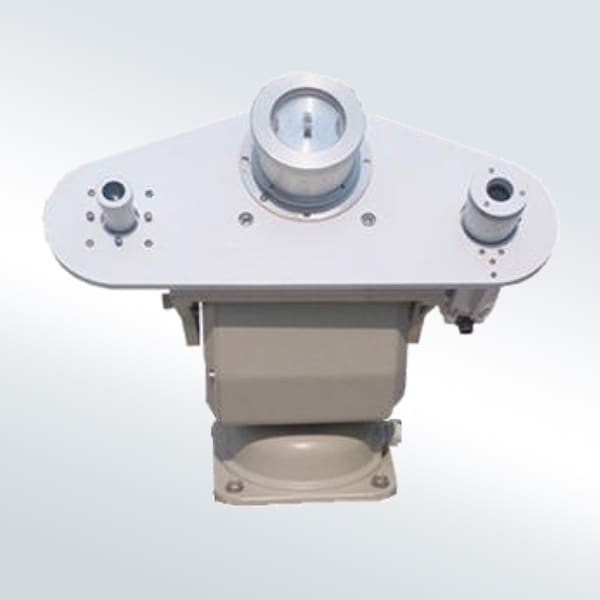
This is the reference configuration of high-quality radiation networks. A two-axis tracker points the pyrheliometer at the sun (measuring I) and keeps a shading disc or ball exactly over a pyranometer, which then measures only the diffuse (D). With a second, unshaded pyranometer measuring G, all three components are measured independently and G = D + I · cos ζ becomes a minute-by-minute quality test.
- Advantages: lowest uncertainty, no geometric corrections, closure of all three components.
- Care points: needs continuous power, alignment, checks on tracking accuracy, frequent cleaning of three sensors and reference-station infrastructure.
- When to use: solar resource assessment, validation of decomposition models and satellite products, reference stations.
2. Pyranometer with shadow ring
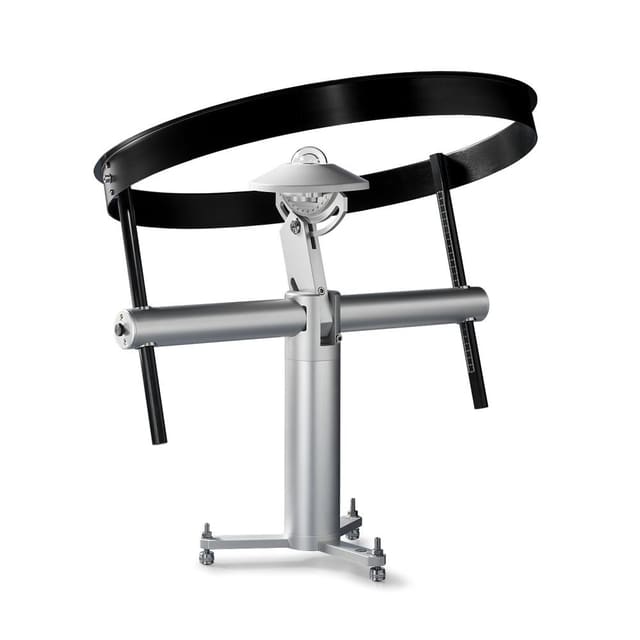
A metal ring, adjusted to the solar declination, blocks the solar disc for a pyranometer all day, so it measures the diffuse. It is a traditional, lower-cost alternative to the tracker and widely used in Brazilian research.
The key teaching point is that the ring also blocks a band of sky, not just the sun. So diffuse measured under a ring needs correction:
- Isotropic (geometric) correction: compensates for the blocked band of sky, assuming a uniform sky; it depends on ring width and radius, latitude and declination.
- Anisotropic correction: the sky is not uniform — near the sun (the circumsolar region) it is brighter, especially under clear skies and with aerosols. In Botucatu, for the Melo-Escobedo ring, the UNESP radiometry group obtained anisotropic factors of about 0.973 (cloudy), 1.045 (partly cloudy) and 1.125 (clear), applied to diffuse already corrected isotropically. Those numbers apply to that ring and that climate — the general message is that without anisotropic correction, clear-sky diffuse tends to be underestimated.
The ring also needs periodic repositioning as the sun's declination changes through the year. Forgetting it lets the sun "escape" the ring and contaminates the record. Hensistemas offers a first-class spectrally flat pyranometer with shadow ring for this setup.
3. Difference method
G is measured with a pyranometer and I with a pyrheliometer on a tracker, and the diffuse is computed as D = G − I · cos ζ. It is physically correct, but at low sun angles small errors in G and I turn into large errors in D. It works better as a check than as the main diffuse measurement.
4. Shadow-mask sensor with no moving parts
This is the most recent and simplest-to-operate solution. Instead of moving a shade to follow the sun, the sensor has several detectors under a dome with a fixed, computer-designed pattern of black and clear bands. The pattern ensures that, wherever the sun is in the sky:
- at least one detector is fully exposed to the solar beam;
- at least one is fully shaded;
- all of them receive half of the diffuse radiation from the sky, sampled from the whole hemisphere.
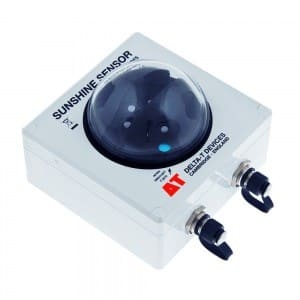
In the global and diffuse solar radiation sensor with sunshine measurement (ref. BF5) from Delta-T Devices, there are seven photodiodes under the dome. The electronics apply each photodiode's calibration and use only the highest (MAX) and lowest (MIN) readings. The highest corresponds to direct plus half the diffuse; the lowest, to half the diffuse. According to the manufacturer's manual:
- Total = MAX + MIN
- Diffuse = 2 × MIN × 1.05 (the 1.05 factor compensates for calibration differences between photodiodes and for the non-uniform diffuse sky; if computed diffuse exceeds total, it is capped at total)
- Horizontal direct = Total − Diffuse
An example in PAR units: MAX = 1500 and MIN = 200 µmol/m²·s give Total = 1700, Diffuse = 2 × 200 × 1.05 = 420 and horizontal Direct = 1280 µmol/m²·s; the beam fraction is 1280/1700 ≈ 0.75.
- Advantages: no ring to adjust, no tracker, no north alignment, no moving parts; it only needs levelling. It works at any latitude, including in the field above a canopy on a tripod.
- Limitations: it is a photodiode sensor, not a thermopile. That has consequences researchers need to understand (see the next section).
What the no-moving-parts sensor actually measures
This is where instrument selection most often goes wrong — so it is worth being precise.
Spectral response is 400 to 700 nm. The photodiodes respond close to photosynthetically active radiation, and the instrument is calibrated against a reference quantum sensor. Its "native" quantities are therefore total PAR and diffuse PAR, in µmol/m²·s.
Energy (W/m²) and illuminance (klux) outputs are conversions. The manufacturer's manual describes the factors used:
- Total energy = total PAR × 0.48
- Diffuse energy = diffuse PAR × (0.48 − 0.48 × BF⁴), where BF is the beam fraction (direct/total), used as an indicator of blue or overcast sky, because the spectrum of diffuse light changes strongly between those conditions
- Illuminance: 1 µmol/m²·s ≈ 55.7 lux
In the example above, total energy would be 1700 × 0.48 ≈ 816 W/m² and diffuse 420 × 0.48 × (1 − 0.75⁴) ≈ 137 W/m². These are useful numbers, but they are not equivalent to the reading of an ISO 9060-classified thermopile pyranometer integrating from 0.3 to 3 µm.
Stated accuracy (product sheet): total radiation ±5 W/m² ±12% and diffuse ±20 W/m² ±15% in energy units (±10 µmol/m²·s ±12% and ±15% in PAR); sunshine hours ±10% against the WMO definition; cosine correction ±10% over 0–90° zenith angle; response time < 250 ms; recalibration recommended every 2 years.
Sunshine status is provided by a digital output (contact closure: no sun = open circuit; sun = short to ground). Because a horizontal sensor cannot measure direct irradiance perpendicular to the beam, the manufacturer uses an empirical criterion tuned to follow the WMO 120 W/m² threshold: sunshine is present when Total/Diffuse > 1.25 and Total > 50 µmol/m²·s. In the example, 1700/420 ≈ 4.0 — the sun is shining.
In practice this means:
- For ecophysiology, canopies, light interception, LAI and the diffuse fraction of PAR, the sensor measures exactly the quantity of interest. It is, in fact, the reference sensor of the SunScan canopy analysis system.
- For sunshine duration, it is a strong replacement for the Campbell-Stokes recorder in new records, with electronic output and no cards to change — but when joining old Campbell-Stokes series, a period of parallel measurement is advisable.
- For high-accuracy energy balance, bankable solar resource assessment or satellite validation, the reference remains thermopile: a first-class or Class A pyranometer and, ideally, a tracker with pyrheliometer.
To understand the difference between radiation in energy and in photons, see our guide to photosynthetically active radiation (PAR) and quantum meters.
Comparing the methods
| Criterion | Tracker + pyrheliometer + shaded pyranometer | Pyranometer with shadow ring | Shadow-mask sensor, no moving parts |
|---|---|---|---|
| Components obtained | Independent G, D and I | D (with G from another pyranometer) | Total, diffuse and sunshine status |
| Moving parts | Yes (tracker) | No, but the ring must be adjusted | No |
| Alignment | Level, north and tracking | Level, polar axis and declination | Level only |
| Diffuse corrections | Minimal | Isotropic and anisotropic | Manufacturer's internal factor |
| Spectral band | Thermopile (0.3–3 µm) in the reference setup; check each sensor's sheet | Thermopile (0.3–3 µm) | 400–700 nm (PAR) |
| Sunshine duration | Directly by the WMO definition | By the pyranometric method | Dedicated digital output |
| Infrastructure | High (continuous power, maintenance) | Medium | Low (AA batteries or external power) |
| Typical use | Reference stations, solar energy | Agrometeorology, long records | Canopies, field work, sunshine, buildings |
Installation and data logging for the no-moving-parts sensor
The sensor's simplicity does not remove the need for a protocol:
- Levelling: the only mechanical adjustment, and the most important. Use the sensor's own bubble level; on a tripod, adjust until the bubble sits in the central circle.
- Clear horizon: like any radiometer, it must see the sky without obstructions — out of the shadow of the mast, trees and buildings in every season. It can be mounted on a camera tripod (¼-inch thread), on a horizontal surface with four M4 bolts, or on an arm on the station mast.
- No north alignment is needed, and no repositioning through the year.
- Clean dome: the dome is acrylic; clean it with soapy water and a soft cloth — never with solvents.
- Desiccant: the indicator inside the dome should be blue; if it is pink, replace the desiccant to avoid internal condensation.
- Heater: the sensor has an internal heater with a separate 12–15 VDC supply, up to 1.5 A. Most of Brazil has no frost, but morning dew is common and droplets on the dome distort the first hours of the day. On solar-powered stations, size the battery to account for heater consumption. The heater ground must be isolated from the signal ground.
- Sensor power: two 1.5 V AA batteries (typical life one year) or an external 5–15 VDC supply. If internal temperature may exceed 50 °C, the manufacturer recommends 1.5 V lithium cells.
- Data logger: there are two analogue millivolt outputs (total and diffuse, 0 to 2500 mV) and a contact-closure sunshine status output. The weather station data logger with telemetry is one option for integrating the sensor into a station; confirm the analogue channel and digital input configuration with our technical team.
- Sunshine in the logger: sample the sunshine status at short intervals (one minute or less) and sum the time in "sun"; also store the hourly fraction, which is more useful for analysis than the daily total alone.
Quality control of the record
A few simple checks keep installation errors from turning into research results:
- Diffuse ≤ total, always (the sensor itself enforces this, but check records from other instruments).
- Zero at night: non-zero night-time values point to offset or grounding problems.
- Diffuse fraction consistent with the sky: low kd on clearly sunny days; kd close to 1 on overcast days. A plot of kd against kt, daily or hourly, should form the characteristic decreasing point cloud; points outside it deserve investigation (shading, dirty dome, dew).
- Sunshine ≤ day length: daily sunshine can never exceed N, the astronomical day length.
- Low sun: with zenith angles above about 80°, cosine errors grow in any radiometer; flag those data.
- Comparison with the station pyranometer: if the station has a thermopile pyranometer, compare daily global radiation. Growing systematic differences indicate dirt, loss of level or the need for recalibration.
- Calibration: the two-year recalibration recommended by the manufacturer should be in the project schedule; field recalibration is not recommended.
How to choose: start from the research question
- "I want the diffuse fraction of light reaching the crop or forest, and LAI." The no-moving-parts sensor measures total and diffuse PAR natively, in the field and above the canopy.
- "I want sunshine duration to calibrate Ångström-Prescott or to replace the Campbell-Stokes recorder." A sensor with a sunshine status output is the simplest solution; for the strict WMO definition, the reference is a pyrheliometer on a tracker.
- "I want diffuse radiation in energy units for a radiation balance or long agrometeorological records." A thermopile pyranometer with shadow ring, with a ring-adjustment protocol and diffuse correction.
- "I want all three components with the lowest uncertainty, for solar energy or satellite validation." A tracker with pyrheliometer and shaded pyranometer, plus a reference pyranometer for global radiation.
Instruments for each setup
- No moving parts, with sunshine duration: global and diffuse solar radiation sensor (BF5).
- Diffuse with shadow ring: first-class pyranometer with shadow ring.
- Direct, diffuse and global with tracking: automatic solar tracking radiometer and the solar monitoring system with tracker for all three components.
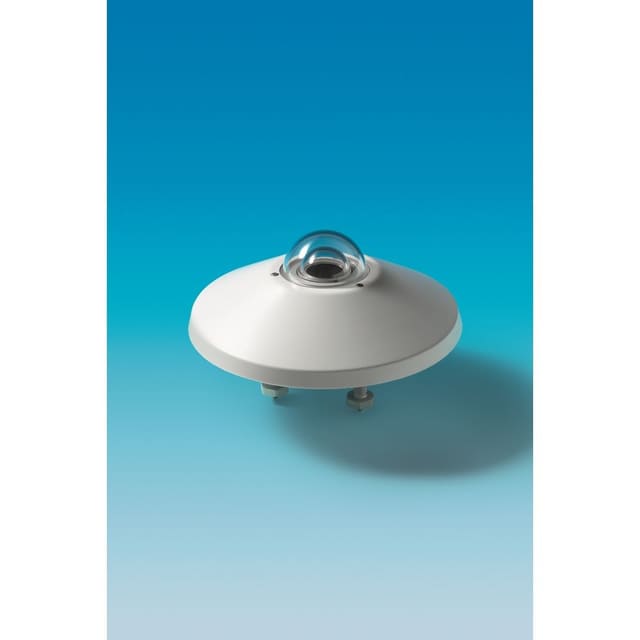
- Thermopile global radiation: first-class spectrally flat pyranometer. Our guide to the pyranometer in the weather station covers classes, installation and quality control.
- PAR at points below the canopy: PAR quantum meters.
- Data acquisition and telemetry: weather station data logger.
Project checklist
- Does the question require diffuse in energy units (thermopile) or in PAR?
- Will sunshine duration be used to extend Campbell-Stokes records? Is a parallel measurement period planned?
- Does the site have a clear horizon all year, and will the sensor stay level?
- Does the station's power budget allow for the heater, if used?
- Does the logger have two millivolt analogue channels and a digital input for sunshine status?
- Is quality control (diffuse ≤ total, kd versus kt, sunshine ≤ N) in the processing plan?
- Are recalibration and cleaning in the schedule?
Further reading
- World Meteorological Organization. Guide to Instruments and Methods of Observation (WMO-No. 8), chapters on radiation and sunshine duration.
- Allen, R. G. et al. Crop evapotranspiration — Guidelines for computing crop water requirements. FAO Irrigation and Drainage Paper 56, 1998.
- Delta-T Devices. BF5 Sunshine Sensor — User Manual, v2.3.
- Dal Pai, A.; Escobedo, J. F. et al. Work by the UNESP Botucatu Solar Radiometry Laboratory on anisotropic correction of shadow-ring diffuse measurements (COBEM 2005; CBENS 2007; Journal of Renewable and Sustainable Energy, 2020).
- Erbs, D. G.; Klein, S. A.; Duffie, J. A. Estimation of the diffuse radiation fraction for hourly, daily and monthly-average global radiation. Solar Energy, 1982.
- Mercado, L. M. et al. Impact of changes in diffuse radiation on the global land carbon sink. Nature, 2009.
Splitting solar radiation into direct and diffuse turns a single record — global radiation — into information about the sky, the clouds and how light reaches plants, modules and buildings. With the right method for the question, a simple installation protocol and well-designed quality control, the diffuse fraction and sunshine duration stop being model estimates and become measured data in your research. To size the sensor, cables, power supply and logger for your experiment, talk to the Hensistemas team.
Instruments for this application
Delta-T DevicesBF5
BF5 Sunshine Sensor (Global and Diffuse Solar Radiation)
DeltaOhm - GHM GroupLPPYRA12
LPPYRA12 Series – Spectrally Flat Class B Pyranometers with Shadow Ring
HenSistemasHS14200-08
HS14200-08 Automatic Solar Tracking Radiometer

EKOSTR-21G-S2
EKO STR-21G-S2 Solar Monitoring System
DeltaOhm - GHM GroupLPPYRA02
LPPYRA02 Series Spectrally Flat Class B (First Class) Pyranometer
Spectrum Technologies3415Fxxx
LightScout Quantum Meters
DeltaOhm - GHM GroupHD33MT.4
HD33MT.4 Data Logger for Weather Station
Keep reading
Hail at the weather station: how to measure hailstone size and energy with an acoustic sensor and use the data in research
A teaching guide to hail measurement: WMO definition, terminal velocity, momentum and kinetic energy of hailstones, measurement methods, how an acoustic impact sensor works, sampling statistics, installation, research use and quality control.
Albedo in research: how to measure reflected solar radiation with an albedometer and use it in the energy balance
A didactic guide to albedo: what it is, why it is not constant, how an albedometer works, how to compute daily albedo, the sensor's field of view, quality control and selection criteria for research in Brazil.
Animal environment in research: how to measure temperature, humidity and black globe in livestock buildings, calculate THI, BGHI and enthalpy and combine them with the weather station
A didactic guide to measuring the thermal environment in poultry houses, dairy barns and paddocks: why a thermometer alone is not enough, black globe temperature, air velocity, the THI, BGHI, radiant heat load and enthalpy indices (with local pressure), choosing a temperature and humidity logger and propagating its error, standard and alternative globes, installation, intercalibration, salt solutions, ammonia, quality control, a worked example, combining with the weather station and applications in Brazilian research.