
Meteorology · Agriculture · Energy · Technical guides
Albedo in research: how to measure reflected solar radiation with an albedometer and use it in the energy balance
A didactic guide to albedo: what it is, why it is not constant, how an albedometer works, how to compute daily albedo, the sensor's field of view, quality control and selection criteria for research in Brazil.
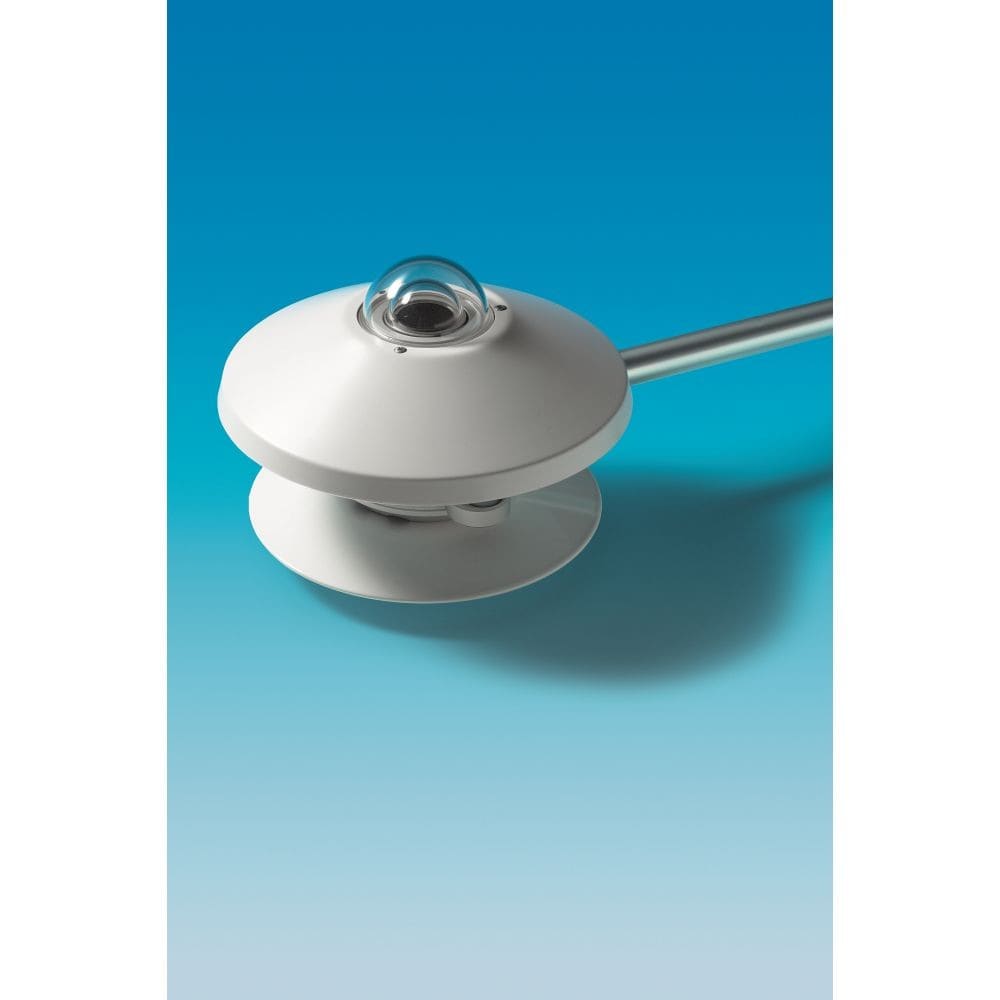
When people talk about solar radiation at a weather station, they almost always picture a pyranometer looking at the sky. But for anyone studying the surface energy balance, evapotranspiration, land-use change, urban thermal comfort or bifacial photovoltaic plants, the other half of the story is underneath the sensor: how much of the incoming radiation the surface sends back. That fraction has a name — albedo — and it is measured with a dedicated instrument, the albedometer.
This guide explains, step by step, what albedo is, why it is not a constant, how an albedometer works, how to compute daily albedo correctly, which installation mistakes distort the data the most, and how to choose the instrument for research in Brazil. It is written for researchers, graduate students and faculty at public universities and research institutes who need reliable time series for a thesis, a paper or a model validation.
What albedo is (and what it is not)
Albedo (α) is the ratio between the global solar radiation reflected by a surface and the global solar radiation reaching it, both measured on the horizontal plane:
α = Rs↑ / Rs↓
where Rs↓ is the incoming global irradiance (direct + diffuse, in W/m²) and Rs↑ is the irradiance reflected by the surface. Albedo is dimensionless, ranges from 0 to 1 and is often reported as a percentage.
Three clarifications prevent common mistakes in reports and thesis defenses:
- Albedo is a shortwave quantity. It covers the solar band (roughly 0.3 to 3 µm). It says nothing about the longwave (thermal infrared) radiation emitted by the surface.
- Albedo is not spectral reflectance. A satellite sensor measures reflectance in narrow bands; broadband albedo comes from integrating over the whole solar spectrum. That is why field data are the reference for validating satellite-derived albedo products.
- Albedo is not net radiation. An albedometer gives you net shortwave radiation, Rns = Rs↓ − Rs↑ = (1 − α) Rs↓. Total net radiation Rn, used in the energy balance, still requires the longwave term, measured with pyrgeometers or a four-component net radiometer.
Why measure albedo in Brazilian research
Land-use change
Albedo is one of the variables that changes the most when forest becomes pasture, cropland or urban area. Long-term measurements at three paired sites in the Brazilian Amazon found a mean albedo of 0.134 for forest and 0.180 for pasture (Culf, Fisch and Hodnett, Journal of Climate, 1995). It looks small, but under 20 MJ·m⁻²·day⁻¹ of incoming radiation that 0.046 difference means about 0.9 MJ·m⁻²·day⁻¹ less shortwave energy absorbed by the pasture — enough to shift the energy balance and the local climate. The same study showed that forest albedo varied through the year in correlation with soil moisture — not because of solar elevation or cloudiness. In other words, albedo is something to measure, not a constant to assume.
Evapotranspiration and the fixed 0.23
In the FAO-56 Penman-Monteith method (covered in our guide to reference evapotranspiration), net shortwave radiation is computed with α = 0.23, the value agreed for the reference grass. That is correct for ET₀. But when the goal is actual evapotranspiration of a crop, a degraded pasture, bare soil after tillage or a specific irrigated plot, using 0.23 by default introduces a systematic error. An albedometer on the experimental plot replaces the convention with a measurement.
Remote sensing and energy-balance models
Algorithms such as SEBAL, METRIC and SAFER — widely used in Brazil to estimate evapotranspiration at basin and irrigation-district scale — depend on surface albedo estimated from Landsat, Sentinel-2 or MODIS imagery. Albedometer field data are the direct way to validate and calibrate those estimates.
Bifacial photovoltaics
Bifacial modules also generate power from their rear side, which receives mostly radiation reflected by the ground. The second edition of IEC 61724-1 (2021), the PV performance monitoring standard, introduced monitoring of bifacial systems, including horizontal albedo and rear-side irradiance. In solar plants and solar-energy research, measured albedo feeds bifacial gain models and allows comparison of ground covers (gravel, grass, bare soil, light-colored membranes).
Urban climate and materials
In studies of urban heat islands, cool roofs and pavements, the albedometer measures real field performance of surfaces, complementing laboratory reflectance tests.
Typical values: a sanity check, not a design table
Micrometeorology textbooks give indicative albedo ranges for natural surfaces. Use the table below to check that your data are in a plausible order of magnitude — not to replace measurement.
| Surface | Indicative albedo range |
|---|---|
| Humid tropical forest | ~0.12–0.14 |
| Pasture and grass | ~0.16–0.26 |
| Field crops at full cover | ~0.15–0.25 |
| Dark wet soil | ~0.05–0.15 |
| Dry light sand | ~0.25–0.45 |
| Water, high sun | ~0.03–0.10 |
| Fresh snow | ~0.75–0.95 |
Notice two lessons. First, the same soil changes albedo when wet: water darkens the surface. Second, water and many surfaces reflect more when the sun is low; hence instantaneous albedo has a typical U-shaped daily cycle, higher early in the morning and late in the afternoon.
How an albedometer works
An albedometer is essentially two pyranometers mounted back to back in one body: the upper one, facing the sky, measures Rs↓; the lower one, facing the ground, measures Rs↑. Both are thermopiles with a black receiving surface, protected by two concentric glass domes that limit the spectral range to the solar band and reduce the effects of wind and thermal exchange. White shade disks above and below keep the body from heating up and block radiation from reaching the sensors sideways.
Each thermopile produces a small voltage proportional to irradiance, through the Seebeck effect. The instrument is passive (no power supply needed) and the typical signal stays below about 20 mV. Irradiance is obtained by dividing the voltage by the sensor's sensitivity, stated in the calibration report:
E = V / S
with V in µV and S in µV/(W/m²).
One design detail matters a lot in daily use: in some models the two pyranometers are matched to the same sensitivity. In that case the ratio of the two voltages is already the albedo, independent of the absolute value of S — which reduces the effect of small calibration errors on the final result. In models without this matching, each sensor has its own coefficient, and albedo must be computed after converting each signal to W/m². Always check the calibration report for one or two coefficients.
Worked example: from signal to daily albedo
Instantaneous value. Assume an albedometer with a common sensitivity S = 9.50 µV/(W/m²), read at noon over a pasture:
- Upper sensor: 8,075 µV → Rs↓ = 8075 / 9.50 = 850 W/m²
- Lower sensor: 1,615 µV → Rs↑ = 1615 / 9.50 = 170 W/m²
- Albedo: 170 / 850 = 0.20 (the same as 1615 / 8075)
- Net shortwave: 850 − 170 = 680 W/m²
Daily value. Daily albedo should not be the arithmetic mean of each interval's albedo. Early-morning and late-afternoon readings, with little energy and low sun, have high values and larger uncertainty, and would pull the mean up. The right way is to divide the daily totals:
α(day) = Σ (Rs↑ · Δt) / Σ (Rs↓ · Δt), that is, the energy reflected during the day divided by the energy received during the day.
If the day added up to Rs↓ = 20.0 MJ/m² and Rs↑ = 4.2 MJ/m², then α(day) = 0.21 and Rns = 15.8 MJ/m².
Impact on evapotranspiration. With the conventional 0.23, net shortwave would be (1 − 0.23) × 20.0 = 15.4 MJ/m². The 0.4 MJ·m⁻²·day⁻¹ difference is equivalent to about 0.16 mm/day of evaporation (factor 0.408 mm per MJ/m²). Over a 120-day campaign that is almost 20 mm of water — a difference that shows up in crop water balances and in comparisons with lysimeters or eddy covariance.
Installation: where most errors start
Height and the area seen by the lower sensor. The downward-facing pyranometer "sees" a circle of ground whose weight decreases with distance, following the cosine response. For a homogeneous surface, the fraction of the signal coming from a circle of radius r below a sensor at height h is:
F = r² / (r² + h²)
This gives a practical rule: 90% of the signal comes from a radius of 3 times the height, and 99% from a radius of about 10 times the height. Installed at 1.5 m, the sensor essentially responds to a circle 4.5 m in radius; at 2 m, 6 m in radius. Manufacturers recommend mounting the albedometer 1 to 2 m above the surface, which means that area must be representative of the treatment being studied and kept that way throughout the campaign — for example, with grass always cut to the same height.
Mast and structure shadows. The mast, the arm and the logger enclosure must not cast shadows in the lower sensor's field of view or reflect light onto the upper one. Mount the albedometer at the end of a sufficiently long horizontal arm and point the arm toward the equator (north across most of Brazil), so the mast's shadow falls behind the sensor. At tropical latitudes, where the sun passes south of the zenith part of the year, check the shadow in summer too.
Clear horizon. Buildings, trees and equipment should not rise above the plane of the upper sensor; if that is not possible, obstructions in the sun's path should stay below about 5° of elevation.
Leveling and orientation. Use the instrument's bubble level; leveling errors mostly affect low-sun hours. In the Southern Hemisphere, the recommendation is to point the connector toward the South Pole.
Grounding and cable. The signal is in microvolts. Use shielded cable, ground the housing locally (without creating a ground loop through the cable) and route the cable away from noise sources.
Data acquisition
Because the albedometer is passive, the logger needs two differential inputs able to read signals of a few millivolts with resolution on the order of 1 µV. Good practices:
- sample every 5 to 10 seconds and store 1- to 15-minute averages, depending on the research question;
- log both irradiances separately (not only the computed albedo), so the data can be reprocessed;
- also log the station's main pyranometer, if there is one, for cross-checking;
- for long series, use a weather station data logger with telemetry and confirm the input configuration for µV signals with our technical team.
Quality control of the series
- Physical limits: Rs↑ cannot exceed Rs↓ over natural snow-free surfaces; albedo above 1 indicates an error.
- Low sun: flag or discard intervals with solar elevation below 10–15° or very low Rs↓ (for example, below 50 W/m²), where cosine and leveling errors dominate.
- Night: slightly negative values at night, of a few W/m², are typical of thermopiles (thermal zero offset). Large deviations point to wiring problems or condensation.
- Dew and rain: droplets on the upper dome in the morning overestimate or distort the reading. Flag the first hours after humid nights.
- Consistency with the station: compare the upper sensor with the station's main pyranometer; systematic differences larger than the class uncertainty indicate dirt, tilt or an expired calibration.
- Management events: record mowing, irrigation, harvest, tillage and rain in the field notebook — all of them change albedo and explain jumps in the series.
Maintenance
- Dome cleaning: water and lens tissue; if needed, pure ethyl alcohol followed by a water rinse. The upper dome collects dust and bird droppings; the lower one, soil splashes during heavy rain.
- Silica gel: the desiccant crystals prevent internal condensation. When they turn from yellow to white or translucent, they have lost efficiency; typical replacement is every 2 to 6 months, depending on climate.
- Calibration: an annual calibration check is recommended. The pyranometers in quality albedometers leave the factory calibrated against a reference traceable to the World Radiometric Reference (WRR), with an individual report.
How to choose an albedometer
1. Pyranometer class. ISO 9060:2018 classifies pyranometers as Class A (formerly "secondary standard"), Class B (formerly "first class") and Class C (formerly "second class"). The class defines non-linearity, cosine response, temperature and tilt dependence — exactly the errors that weigh most on albedo at low sun.
2. Matched sensitivities. Prefer models with both sensors matched to the same sensitivity when albedo is the main output; this simplifies processing and makes the ratio less sensitive to absolute calibration errors.
3. Application.
- Research in micrometeorology, ecophysiology, satellite validation and energy balance: an albedometer with Class B pyranometers is usually the best balance between uncertainty and cost.
- Comparative monitoring, teaching, urban-climate studies and campaigns with many replicates: an albedometer with Class C pyranometers lowers the cost per point.
- Bifacial PV plants complying with IEC 61724-1 Class A: the standard requires a spectrally flat Class A pyranometer facing up, while allowing a lower-class downward sensor. Here the solution tends to be modular, with a Class A pyranometer for incoming radiation.
4. Integration with the station. Check the number of free differential inputs on the logger, the cable length needed to the arm and mounting compatibility (16 mm rod on the models below).
Comparing the two versions in our catalog
The data below come from the manufacturer's documentation and refer to each of the two pyranometers that make up the albedometer.
| Feature | Albedometer with first-class pyranometers (Class B) | Albedometer with second-class pyranometers (Class C) |
|---|---|---|
| Typical sensitivity | 6 to 12 µV/(W/m²) | 5 to 15 µV/(W/m²) |
| Measuring range | 0 to 2000 W/m² | 0 to 2000 W/m² |
| Spectral range (50%) | 283 to 2800 nm | 300 to 2800 nm |
| Response time (95%) | < 28 s | < 30 s |
| Non-linearity | < ±1% | < ±2% |
| Cosine response | < ±18 W/m² | < ±22 W/m² |
| Spectral selectivity | < ±5% | < ±7% |
| Temperature response | < 4% | < 8% |
| Tilt response | < ±2% | < ±4% |
| Weight (complete) | 1.35 kg | 1.1 kg |
The first-class albedometer ships with upper and lower shade disks, a silica-gel cartridge with refills, a leveling device, a 16 × 500 mm mounting rod and a calibration report; the cable is ordered separately. See the full datasheet of the albedometer with first-class pyranometers (LPPYRA05), and the lower-cost option, the albedometer with second-class pyranometers (LPPYRA06).
Instruments that complete a radiation study
- A stand-alone first-class pyranometer for the station's global irradiance: spectrally flat Class B pyranometer. For classes, installation and QC of the pyranometer, see the guide to the pyranometer at the weather station.
- Diffuse radiation, to split the components of incoming radiation: pyranometer with shadow ring.
- Direct, diffuse and global at once, at reference and solar-energy stations: automatic solar-tracking radiometer.
- Light for photosynthesis, when the question is physiological rather than energetic: see the guide to photosynthetically active radiation (PAR) and quantum meters.
Checklist for your research project
- Does the question require measured albedo, or is the convention (0.23 for ET₀) enough?
- Is the area within 3 × h around the sensor representative, and will it be kept that way?
- Is the arm pointed toward the equator and free of mast shadow in every season?
- Does the logger have two differential inputs with µV resolution?
- Will daily albedo be computed as the ratio of totals, with low-sun and dew QC?
- Is there a plan for cleaning, silica-gel replacement and an annual calibration check?
- Will total net radiation be needed? If so, is a longwave measurement planned?
Measuring albedo is, at heart, measuring how a surface decides how much energy stays and how much goes back to the atmosphere. With the right instrument, properly installed and with a simple quality protocol, this number stops being a parameter taken from a table and becomes a result of your research. To size the albedometer, cables and logger for your experimental site, talk to the Hensistemas team.
Instruments for this application
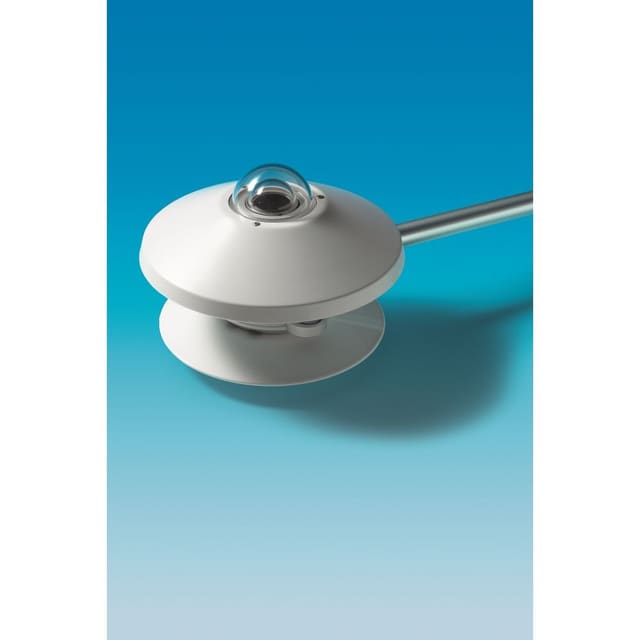
DeltaOhm - GHM GroupLPPYRA05
LPPYRA05 – Albedometer with First Class Pyranometers
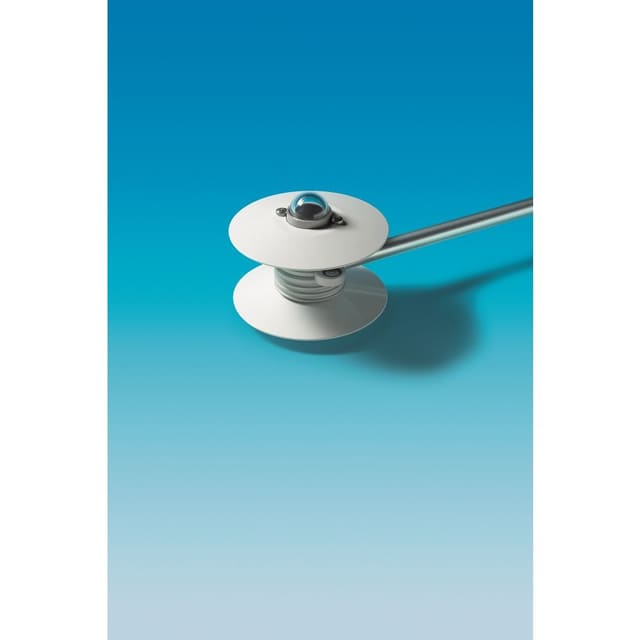
DeltaOhm - GHM GroupLPPYRA06
LPPYRA06 – Albedometer with Second Class Pyranometers
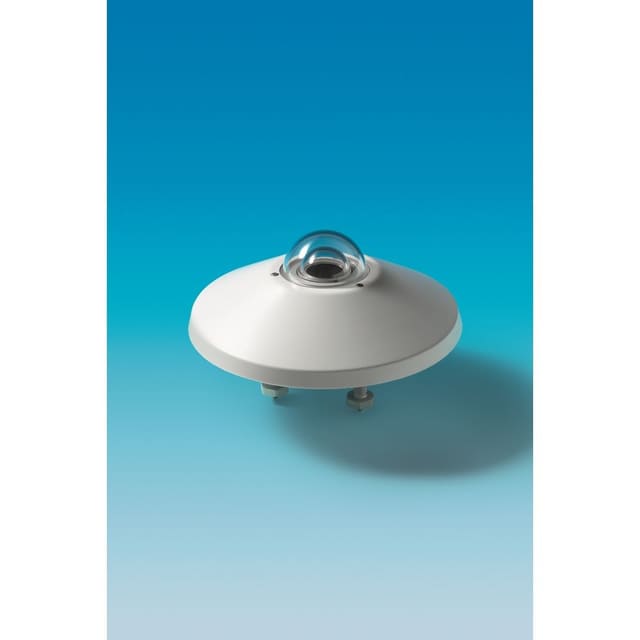
DeltaOhm - GHM GroupLPPYRA02
LPPYRA02 Series Spectrally Flat Class B (First Class) Pyranometer

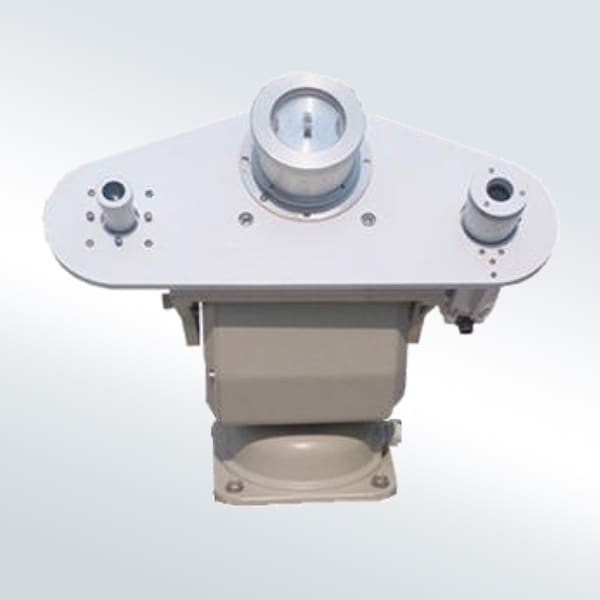
HenSistemasHS14200-08
HS14200-08 Automatic Solar Tracking Radiometer
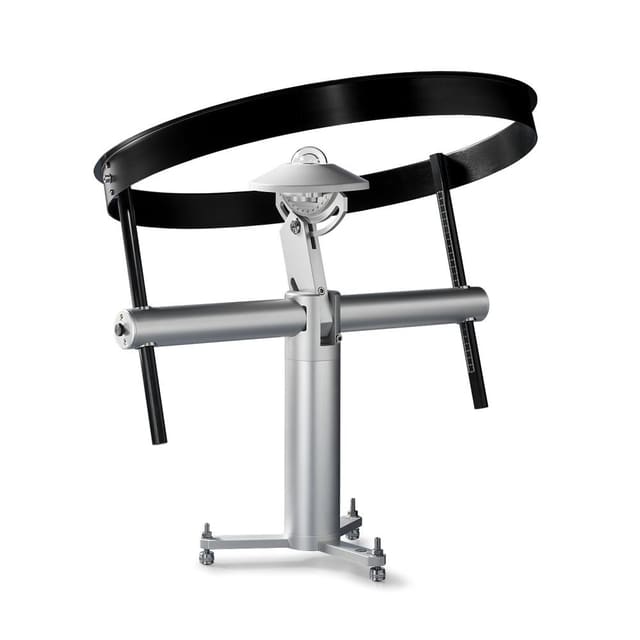
DeltaOhm - GHM GroupLPPYRA12
LPPYRA12 Series – Spectrally Flat Class B Pyranometers with Shadow Ring
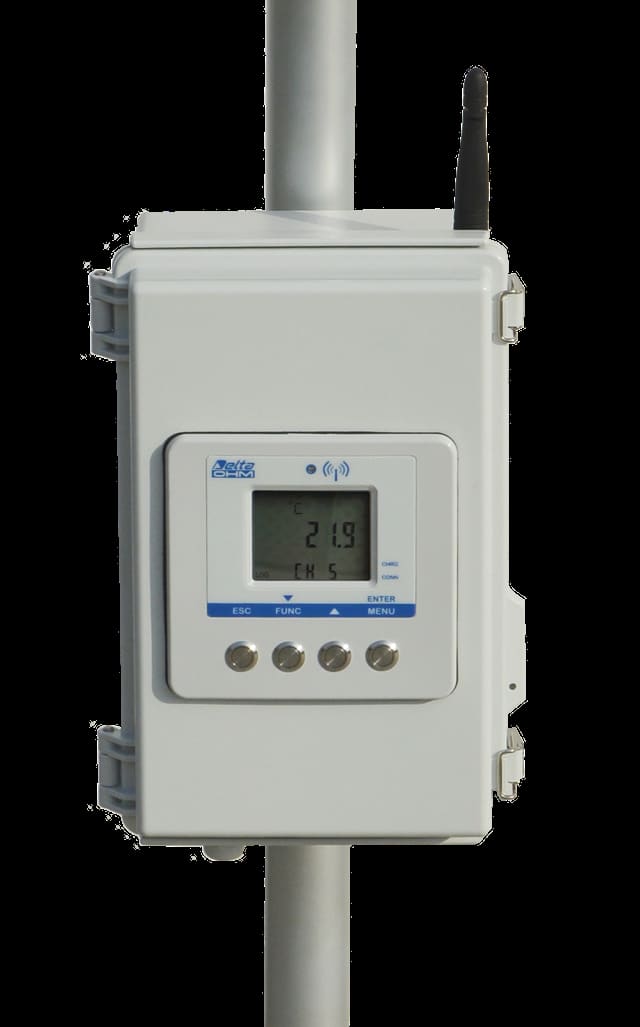
DeltaOhm - GHM GroupHD33MT.4
HD33MT.4 Data Logger for Weather Station
Keep reading
Hail at the weather station: how to measure hailstone size and energy with an acoustic sensor and use the data in research
A teaching guide to hail measurement: WMO definition, terminal velocity, momentum and kinetic energy of hailstones, measurement methods, how an acoustic impact sensor works, sampling statistics, installation, research use and quality control.
Diffuse radiation, direct radiation and sunshine duration at the weather station: how to separate solar radiation components in research
A didactic guide to global, direct and diffuse radiation and sunshine duration: the WMO definition, Ångström-Prescott, sun trackers, shadow rings and sensors with no moving parts, with worked examples, quality control and selection criteria for research in Brazil.
Animal environment in research: how to measure temperature, humidity and black globe in livestock buildings, calculate THI, BGHI and enthalpy and combine them with the weather station
A didactic guide to measuring the thermal environment in poultry houses, dairy barns and paddocks: why a thermometer alone is not enough, black globe temperature, air velocity, the THI, BGHI, radiant heat load and enthalpy indices (with local pressure), choosing a temperature and humidity logger and propagating its error, standard and alternative globes, installation, intercalibration, salt solutions, ammonia, quality control, a worked example, combining with the weather station and applications in Brazilian research.