
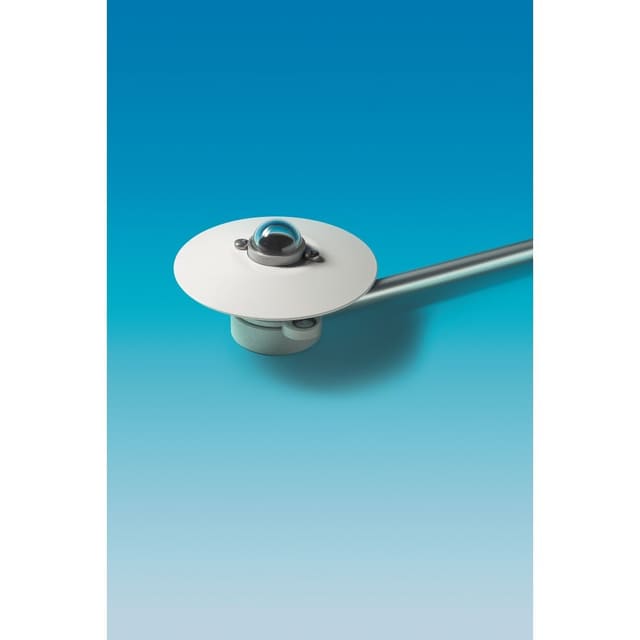
DeltaOhm - GHM GroupLPPYRA03
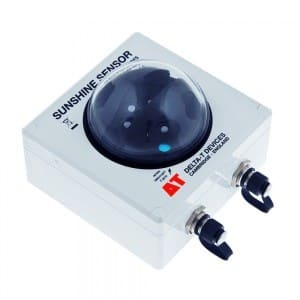
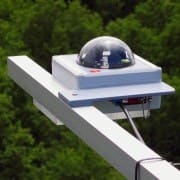
Light, Solar Radiation and PAR
Measures global and diffuse radiation as well as sunshine duration, with no moving parts and no shade rings.
It is the PAR reference sensor for the SunScan system, and its outputs can be set to PAR (µmol.m-2.s-1), energy (W.m-2) or lux.
Price on request
No sign-up. You review the list and send it when you are ready.
Torn between two models?
Ask on WhatsAppSaves this product and the next ones you view in this browser, up to eight, for 30 days. You can disable it under “History” in the footer.
History is enabled in this browser. History
The BF5 measures incoming solar radiation with an array of photodiodes under a unique, computer-generated shading pattern. A microprocessor works out the global and diffuse components of the radiation and decides whether the sun is shining.
Two analog voltage outputs carry the global and diffuse radiation, from which direct radiation is derived, while a digital output signals the sunshine status. All three outputs can be wired to the matching channels of GP1 or GP2 data loggers, or to other loggers commonly used for environmental monitoring. An internal heater keeps the BF5 free of dew, ice and snow down to -20 °C.
Sunshine hours are derived indirectly, using a simple equation based on total PAR (Photosynthetically Active Radiation) and on the ratio between total and direct PAR. The algorithm closely follows the World Meteorological Organization (WMO) threshold of 120 W.m-2 in the direct solar beam. Because the sensor never needs adjusting or repositioning to track the sun, it has a clear advantage over shade-ring devices.
The BF5 can work as an integral component of the SunScan canopy analysis system. The SunScan probe is a 1 m long array of light sensors for measuring PAR interception by plant canopies and estimating LAI (leaf area index). With the BF5, SunScan becomes more accurate and can be used even when light conditions change.
Beyond SunScan, the alternative outputs make the BF5 useful for photosynthesis studies, lighting work and solar energy measurement.
In building energy management systems (BEMS), the BF5 can drive the opening and closing of blinds in response to sunlight. Since it measures direct light energy and total radiation at the same time, it helps make the most of daylight and solar gain while reducing glare for the people inside.
The SPN1 Sunshine Pyranometer is a precision version of the BF5. The two instruments share some features but differ in important ways, summarized in the document “SPN1 and BF5 Comparison Data Sheet”.
Simultaneous outputs for total radiation, diffuse radiation and sunshine status. The output can be preset to PAR, energy or illuminance (lux) units.
By output setting (PAR / energy / illuminance):
General data:
| Property | Value |
|---|---|
| Sunshine hours accuracy | ±10% compared to the WMO definition |
| Cosine correction accuracy | ±10% of incoming radiation over 0-90° zenith angle |
| Azimuth angle accuracy | ± 5% over 360° rotation |
| Temperature coefficient | ± 0.15 % /°C (typical) |
| Temperature range | -20 to + 50°C with alkaline batteries; -20 to + 70°C with lithium batteries |
| Stability | Recalibration recommended every 2 years |
| Response time | < 250 ms |
| Spectral response | 400-700 nm |
| Latitude capability | -90° to + 90° |
| Environmental protection | IP65 (shower and dust proof) |
| Sunshine status (contact closure) | No sun = open circuit; sun = short circuit to ground |
| Internal battery | 2 x 1.5 V AA alkaline batteries |
| Power requirement | 2 mA (awake), <30 µA (asleep) |
| Heater power | 12 V – 15 VDC, up to 1.5 A |
| Battery lifetime | 1 year (typical) |
| Input voltage range, internal battery | 1.4 to 3.6 VDC |
| Input voltage range, external power | 5 to 15 VDC |
| Fuse trip point on sunshine status signal (switch-closure mode) | 0.5 A, 30 V (self-resetting) |
| Maximum voltage on sunshine status output (contact closure mode) | 0 to 24 V |
| RS232 connector | 5-pin M12 |
| Signal output and power-in connector | 8-pin M12 |
| Mounting options | Camera tripod socket (¼ inch Whitworth); holes for 4 x M4 bolts at the corners of the box |
| Size and weight | 120 mm x 122 mm x 95 mm, 635 g |
DeltaOhm - GHM GroupLPPYRA03
DeltaOhm - GHM GroupLPUVA02AC
Spectrum Technologies3668I
DeltaOhm - GHM GroupLPPYRA02
Tell HenSistemas about your application.