
Meteorology · Agriculture · Technical guides
Air temperature and humidity at the weather station: how to choose the sensor and radiation shield for research
A teaching guide to air temperature and humidity at the weather station: FAO-56 quantities (vapour pressure, VPD and dew point), why the radiation shield matters as much as the sensor, WMO height and siting, drift at high humidity, calibration, quality control and a researcher checklist.
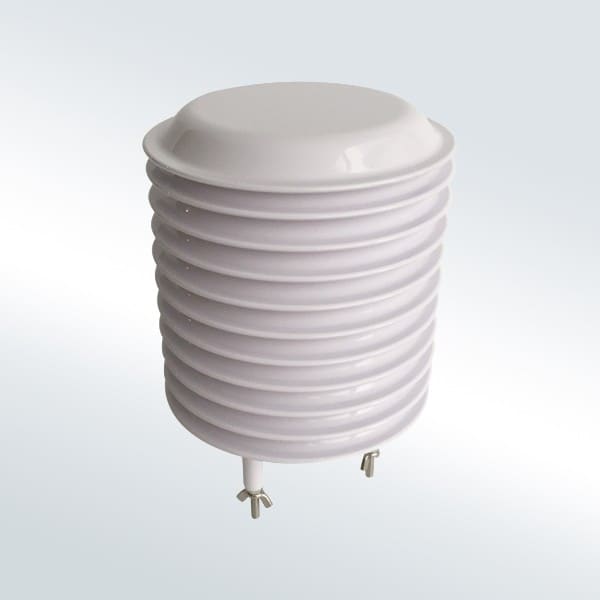
Air temperature and humidity look like the simplest variables in a weather station. Any wall-mounted thermo-hygrometer shows both numbers. In research, though, these are exactly the two measurements most exposed to silent errors: a good sensor inside a poor shield, or installed in the wrong place, can record the day 1 to 2 °C warmer than the real air, and the series still looks perfectly normal on the chart.
These numbers feed many of the analyses run at Brazilian universities and research institutes: FAO-56 reference evapotranspiration, the vapour pressure deficit (VPD) used in plant physiology, degree-days for phenology and pests, fungal disease risk models, animal and human thermal comfort indices and urban climate studies. This guide explains, step by step, what is actually measured, why the shield matters as much as the sensor, how to install it following the World Meteorological Organization guide (WMO-No. 8) and how to handle calibration and quality control.
What is measured and what is calculated
A station's air temperature is the temperature of the free air in the shade, measured by a sensor protected from radiation and well ventilated. It is not the temperature of the sun, of the ground or of the equipment box.
Relative humidity (RH) is the ratio, in percent, between the water vapour pressure in the air and the saturation vapour pressure at the same temperature. Because saturation depends strongly on temperature, RH only makes sense together with the temperature at which it was measured. That is why research sensors measure both quantities at the same point.
From that pair you calculate the quantities many studies really need. The FAO-56 paper gives the most widely used equations:
- Saturation vapour pressure: e°(T) = 0.6108 × exp[17.27 × T / (T + 237.3)], in kPa, with T in °C (equation 11).
- Actual vapour pressure: eₐ = e°(T) × RH / 100.
- Vapour pressure deficit: VPD = e°(T) − eₐ.
- Dew point: T_dew = (116.91 + 237.3 × ln eₐ) / (16.78 − ln eₐ) (equation 14).
A worked example fixes the order of magnitude. With air at 30 °C and 60% RH, e°(30) ≈ 4.24 kPa, eₐ ≈ 2.55 kPa, VPD is about 1.70 kPa and the dew point about 21.4 °C.
For daily evapotranspiration, FAO-56 recommends computing eₐ from the day's extremes: the mean of e°(Tmin) × RHmax and e°(Tmax) × RHmin (equation 17). In other words, the station must record the extremes well, and those are the moments most prone to error: the sunny, windless late morning and the near-saturated small hours.
Why the shield matters as much as the sensor
A sensor exposed to the sun largely measures its own heating. The WMO guide lists the main sources of error in temperature measurement: direct and indirect radiation (from the sun, clouds, the ground and nearby objects), insufficient shield ventilation, especially with wind below 1 m/s and strong radiation, evaporative cooling when the shield or sensor is wet, and dirt.
Two physical points explain the size of the problem:
- Heat exchange between sensor and air is weak. According to the WMO, it improves with the square root of air speed and worsens with the square root of sensor diameter. In nearly still air, any radiation load becomes error.
- The shield itself heats up. In naturally ventilated louvred screens, the WMO notes that the inside air tends to be warmer than the real air on sunny, calm days and slightly cooler on clear, calm nights, with errors that can reach about +2.5 K and −0.5 K in extreme cases.
The effect on humidity is less intuitive. Go back to the example: if the shield warms the assembly by 1 °C, the sensor reads 31 °C and measured RH drops from 60% to about 56.7%, because the vapour in the air has not changed but saturation at the sensor's temperature has risen. Calculated VPD goes from 1.70 to about 1.95 kPa, an error of almost 15%. Interestingly, the dew point calculated from the measured pair stays practically correct, since it depends only on the amount of vapour. The lesson is useful for quality control: temperature, RH and VPD are sensitive to the shield; dew point is far more robust.
Types of shield
- Louvred screen (Stevenson type): the classic wooden or plastic box with double-louvred walls and a ventilated roof. It is the historical reference for conventional stations, but it is large and has high thermal inertia.
- Multi-plate shield: a stack of plates, usually white plastic, with natural ventilation. It is the standard on most compact automatic stations. More plates increase protection and inner space, at the cost of height and some response lag.
- Fan-aspirated shield: a fan draws air over the sensor. It greatly reduces error on low-wind days, but it uses power and the fan must be monitored; the WMO recommends that fan status be shown on the shield itself or in the data.
On materials, the WMO notes that polished metal reflects radiation well, but insulating plastics with low thermal conductivity are preferable because they are easier to maintain, and they are required when the shield relies on natural ventilation. White, clean and crack-free is the minimum. Shields that are dirty or yellowed by the sun lose reflectance and slowly increase the error without anyone noticing.
Where and how to install
The WMO-No. 8 guide recommends measuring temperature and humidity between 1.25 and 2 m above the ground, over natural ground, preferably grass, on a level site freely exposed to sun and wind. Measurements on rooftops are considered of doubtful significance because of the building's own influence.
The WMO siting classification (annex to chapter 1 of the guide) gives objective criteria that work as a checklist for a site visit:
- Class 1: flat ground with a slope under 19°, covered by low natural vegetation (under 10 cm), more than 100 m from artificial heat sources or reflective surfaces (buildings, concrete, car parks) and from bodies of water, and free of shade when the sun is above 5°.
- Class 2: the same ground conditions, with at least 30 m from those surfaces and no shade with the sun above 7°.
The annex also points out that irrigated areas, lakes and ponds are moisture sources to take into account, an important point on experimental farms. In practice:
- Fixed, documented height. Never below 1.25 m; between 1.5 and 2 m the temperature difference is, according to the WMO, less than 0.2 °C.
- Temperature and humidity in the same shield at the same height. Mixing temperature from one point with RH from another makes eₐ, VPD and dew point meaningless.
- Mown grass and a maintained surrounding. The classification assumes regular vegetation maintenance. Tall weeds around the shield change the microclimate.
- No nearby obstacles. Walls and trees shade the shield by day and send infrared radiation back at night.
- Sensor properly placed inside the shield, not touching the plates and with the tip pointing down or in the position the manufacturer specifies, so water does not collect on the filter.
- Photos of the four quadrants at every visit and a record of any change around the site. It costs little and saves the interpretation of long series.
If your study needs measurements inside a crop canopy, a greenhouse, an animal house or along vertical profiles, that is perfectly valid, but it is a different scientific question: describe height and exposure in the methods and do not compare directly with data from a standard station.
What to look for in the sensor
Most current sensors combine a capacitive polymer element for humidity, which the WMO describes as the most convenient and dominant technology for RH, with a temperature element in the same body. When comparing datasheets, look beyond the headline number:
- Accuracy by range. Humidity accuracy usually gets worse above 90% RH. In humid Brazil, nights close to saturation are routine, and that is exactly where error grows.
- Temperature accuracy across the range you will use, not only at 25 °C.
- Long-term stability, in % RH per year. It sets the recalibration interval.
- Response time. For temperature, the WMO recommends a time constant of about 20 s: sensors that are too fast follow fluctuations of one or two degrees within seconds, and sensors that are too slow lag behind real changes.
- Protective filter. The WMO considers a filter essential to prevent progressive contamination. Prefer replaceable filters.
- Output and power draw. Analogue (0–10 V, 4–20 mA), digital (SDI-12, RS485 Modbus) or wireless. On solar-powered stations, standby consumption matters.
SDI-12 in a nutshell
SDI-12 is a 1200-baud serial protocol designed for environmental sensors. It uses three wires (power, ground and data), and each sensor has an address, so temperature and humidity, pressure and other sensors can share the same bus. The logger requests a measurement, the sensor answers digitally and goes back to low-power mode. For research, the advantages are no analogue conversion error along the cable, readings directly in physical units and easy replacement of one sensor with another of the same standard.
High humidity, dew and drift
This is where many RH series are lost. The WMO guide describes three behaviours of electronic sensors every researcher should know:
- Wetting and recovery. Capacitive sensors that get wet usually recover, at least partly, after drying. While there is dew on the filter or the element, however, the reading is distorted.
- Upward drift. Long exposure to high or condensing humidity, such as dew, fog and rain, is associated with long-term drift, most often upwards. The classic symptom is the sensor reading 100% when the air is at 95%, or spending whole nights stuck at 100%.
- Hysteresis. The sensor may read differently depending on whether it reaches a condition from a wetter or a drier state.
The WMO also notes that at stations in damp climates, the service life of electronic RH sensors is commonly between six months and two or more years, with significant drift before that. Heated sensors tend to be less prone to drift. For anyone working on the coast, in the Amazon, in the Atlantic Forest or in irrigated areas, the practical consequence is to plan sensor replacement or recalibration as a routine project item, not as an exception.
At the other extreme, the Cerrado and the semi-arid northeast have dry-season afternoons with very low RH. There, shield error on low-wind days weighs more, because a heated sensor underestimates RH exactly when it is already critical.
Calibration and quality control
- Laboratory calibration. The WMO recommends traceable calibration in a laboratory accredited to ISO/IEC 17025, usually in a climatic chamber. In Brazil, look for laboratories in the Brazilian Calibration Network (RBC) accredited by Inmetro for temperature and humidity.
- Field checks. The most practical method, according to the WMO, is comparison with a calibrated electronic hygrometer, left to equilibrate with the local temperature and with a suitable response time. Saturated salt solutions (lithium chloride, about 11% RH; sodium chloride, about 75%; potassium sulphate, about 97%, at 25 °C) are useful for checks in a controlled environment, but the WMO warns it is hard to be confident about them in the field. Aspirated psychrometers also work as a reference, as long as they are kept away from the sensor, because they release vapour.
- Maintenance. Clean the shield, inspect the filter and replace it when dirty, and never clean the sensing element in the field, which would alter its calibration.
- Data quality control. Look for RH above 100%, hours or days stuck at 100%, dew point higher than air temperature, daytime maxima that jump on calm days and steps after maintenance visits. Comparing with the nearest INMET automatic station, allowing for differences in exposure, helps detect drift. Calculating dew point and comparing it with the neighbouring station is a simple check: it varies less across space than RH does.
Keep the raw data, record height, model, serial number, calibration and filter-change dates, and keep the station logbook up to date.
An example from the catalogue
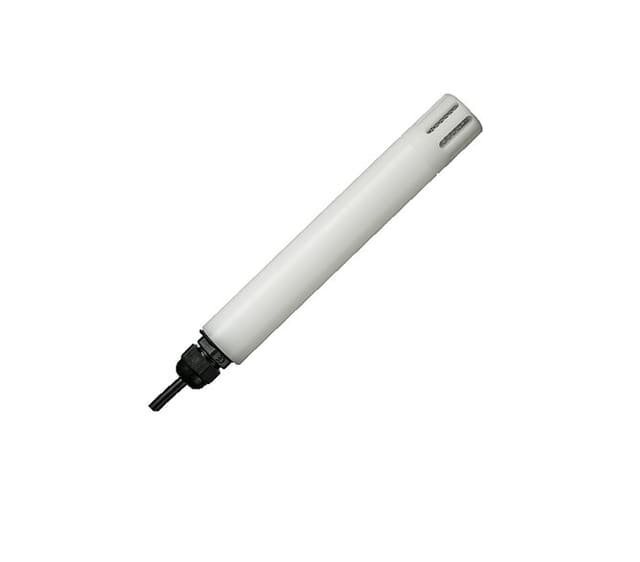
In the HenSistemas catalogue, the relative humidity and temperature sensor with SDI-12 output (model SRH1A) is a good example of a probe designed for research weather stations. According to the manufacturer's datasheet, it measures 0 to 100% RH and −40 to +60 °C, with accuracy at 25 °C of ±1.8% RH from 0 to 90% and ±3.0% above 90%. For temperature, the product description quotes ±0.2 °C, while the specification table gives ±0.3 °C from 0 to 60 °C and ±0.5 °C over the rest of the range; for your study's uncertainty budget, use the more conservative figure.
The datasheet also lists 0.01% RH and 0.01 °C resolution, typical stability better than 0.25% RH and 0.02 °C per year, a 4 to 16 Vdc supply and a draw under 1 mA at 12 V, which helps on solar-powered stations. The housing is POM-C, a rigid plastic with low water absorption, with a 33 µm stainless steel filter at the tip and electronics sealed in epoxy resin; protection is IP66 for the electronics and IP40 for the sensing element. The standard cable is 1 m, with other lengths on request.
Two precautions follow from what we covered above. First, the manufacturer itself specifies installation inside a radiation shield, which protects the probe from water, dust and direct sun. Second, it warns that dew forming on the probe distorts readings until the filter and element dry, so the mounting position must keep water from entering and collecting. The ±3% band above 90% RH is the figure to consider at sites that spend many hours near saturation. The capacitive element can be recalibrated with specialist equipment.
Related products
- Multi-plate radiation shield: white ABS engineering plastic, 4 to 20 plates (typically 11, 14 or 19), 62 mm inner diameter and an optional 304 stainless steel bracket. Check that the diameter of the probe you choose fits the inner space.
- Humidity and temperature transducer with anti-condensation heating: 0–10 V or 4–20 mA output, calculated dew point, absolute humidity or mixing ratio, and an optional relay; suited to greenhouses, animal houses, chambers and environmental control, where analogue output and alarms matter more than meteorological-grade accuracy.
- IP68 wireless temperature and relative humidity sensor: for dense networks in greenhouses, microclimate experiments or profiles inside crops, with up to 3 km line-of-sight range and long battery life. Outdoors, it should also sit inside a radiation shield.
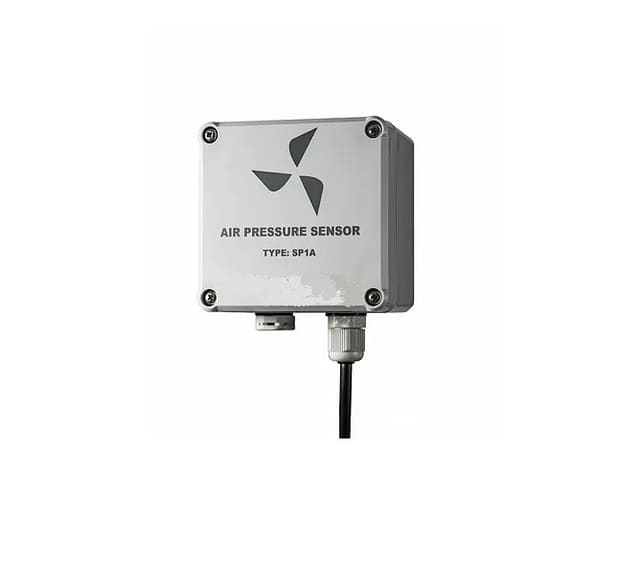
- Air pressure transmitter with SDI-12 output: completes the station's thermodynamic set on the same SDI-12 bus, with ±1.5 mbar accuracy.
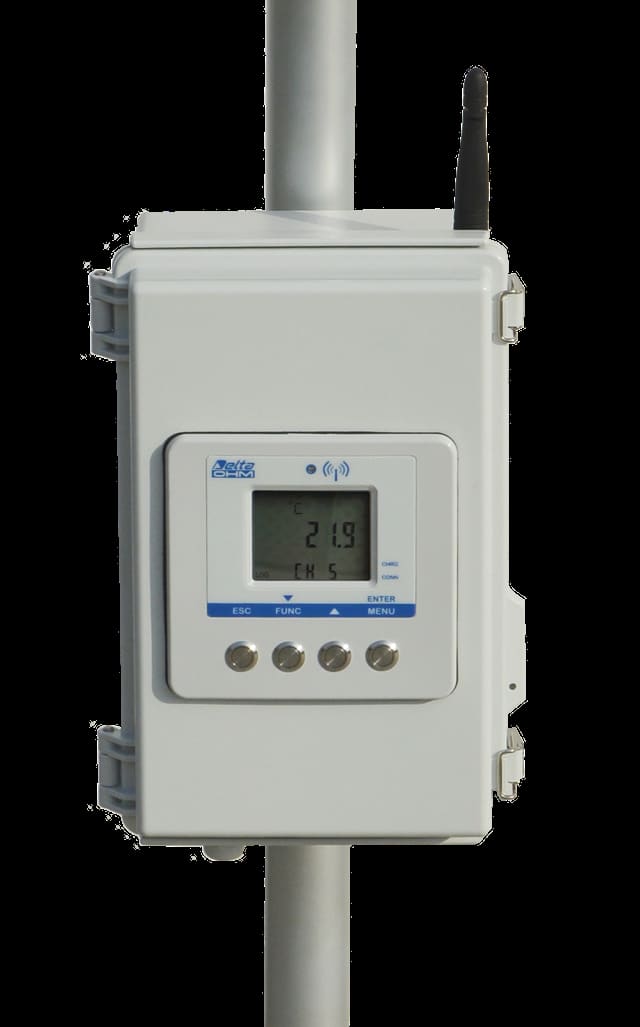
- Weather station data logger with 4G transmission: with an SDI-12 master port and RS485 Modbus-RTU to read the sensors above and send data to the cloud.
For the full picture, see also the guides How to choose a weather station, Pyranometers in weather stations and Data logger: how to choose the right one.
Checklist before requesting a quote
- What will the data be used for: evapotranspiration, VPD, degree-days, disease models, thermal comfort or urban climate? That sets the required accuracy and logging interval.
- Does the site allow a height of 1.25 to 2 m over grass, away from concrete, buildings, ponds and irrigated areas, meeting at least the WMO class 2 criteria (30 m)?
- Will the shield be naturally ventilated or fan-aspirated? Does local wind usually stay below 1 m/s at the critical hours?
- Does the site spend many hours near saturation? If so, look at accuracy above 90% RH, heated sensors and a replacement or recalibration plan.
- Does the logger read the chosen output (SDI-12, RS485 Modbus, 0–10 V or 4–20 mA), and is there enough power for an aspirated shield if needed?
- Who will clean the shield, change the filter, run field checks and keep the metadata?
Answering these questions before the quote avoids discovering, months later, that the maxima were inflated by the shield or that RH spent the rainy season stuck at 100%. If you would like help matching your research protocol to the catalogue, talk to the HenSistemas team.
Instruments for this application
EIC2895-01
Multi-Plate Radiation Shield
fuehlersystemeRAFT/A
RAFT/A Humidity / Temperature Transducer
DeltaOhm - GHM GroupHD33MT.4
HD33MT.4 Data Logger for Weather Station
Keep reading
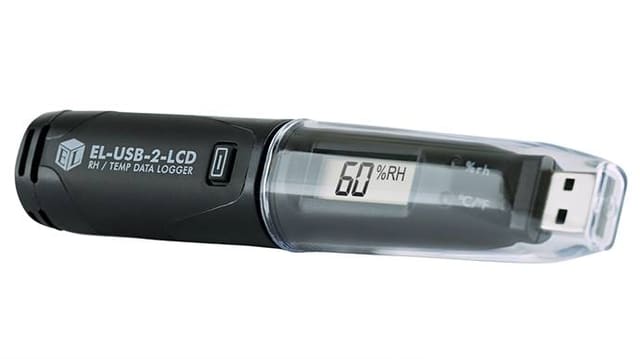
Animal environment in research: how to measure temperature, humidity and black globe in livestock buildings, calculate THI, BGHI and enthalpy and combine them with the weather station
A didactic guide to measuring the thermal environment in poultry houses, dairy barns and paddocks: why a thermometer alone is not enough, black globe temperature, air velocity, the THI, BGHI, radiant heat load and enthalpy indices (with local pressure), choosing a temperature and humidity logger and propagating its error, standard and alternative globes, installation, intercalibration, salt solutions, ammonia, quality control, a worked example, combining with the weather station and applications in Brazilian research.
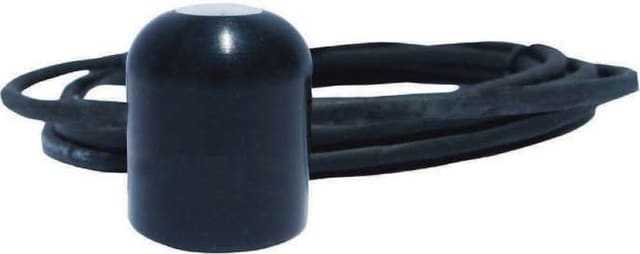
Silicon-cell pyranometer at the weather station: when it is enough, where the errors come from and how to calibrate it against a thermopile
A didactic guide to silicon photodiode pyranometers at research stations: how they work, why calibration holds for clear skies, spectral error under clouds and in reflected light, cosine response, temperature, dirt on the acrylic diffuser and drift, what ISO 9060:2018 says (Class C, not spectrally flat), when the sensor is enough, field cross-calibration against a thermopile with a clear-sky filter and worked example, the FAO-56 Rso envelope, integration to MJ/m²·day, effect on ET₀, dense low-cost networks and Brazilian references.
Spectral light quality in plant research: how to measure the spectrum with a spectroradiometer under LEDs, coloured shade nets and greenhouses and combine it with weather-station PAR
A didactic guide to measuring spectral light quality in plant research: quantity vs. quality, how a spectroradiometer works, PPFD, ePAR (400–750 nm), band fractions, R:FR ratio and PSS calculated from the spectrum, why lux cannot equalise treatments, Brazilian examples with coloured nets and in vitro LEDs, measurement campaigns, transmittance of nets and vessels, instrument limits and combination with continuous weather-station PAR.